Why Ivory Coast Is the Right Next Step for West African University Sport
Right now, as the 2026 FIFA World Cup gets underway in North America, Ivory Coast’s footballers are competing on the largest stage in sport. Their squad carries a market value above €515 million, the highest of any African team at the tournament. Amad Diallo of Manchester United is making his World Cup debut. Franck Kessié, with over 100 caps, is leading a generation of Ivorian talent that includes Bundesliga stars, Premier League regulars, and one of the most tactically coherent squads Africa has ever sent to a World Cup.
That talent did not appear from nowhere. It came from somewhere. From academies. From youth competitions. From the structured development pathways that have been building in Ivory Coast for years at the professional and semi-professional level.
What does not yet exist, at scale, with production infrastructure, with data capture, with broadcast reach, is the university layer. The competition environment that sits between youth development and professional football and contains, right now, some of the most talented athletes in West Africa who are playing in competitions that the professional world cannot see.
That gap is the market HiSL is entering. And the evidence for why the timing is right, and why no other market in Francophone West Africa presents the same convergence of conditions, is not a strategic argument. It is a documented set of facts.
Ivory Coast’s players are at the World Cup. The next generation is at university, competing in competitions the professional world cannot see. That is the gap the platform is built to fill.
The Market Facts: What the Data Actually Says About Ivory Coast in 2026
Before making any strategic argument about why Ivory Coast belongs in the pilot expansion, it is worth anchoring that argument in what is actually verifiable about this market.
With 6% real GDP growth in 2024 (World Bank Country Overview, 2025), Ivory Coast’s economy has averaged 6.5% annual growth since 2021, well above the global average of 2.8% and the regional average of 3.2%. This is the fastest-growing major economy in ECOWAS.
GDP per capita: $2,900 (2024) (IMF via Dabafinance, 2025), The highest GDP per capita in West Africa after Cape Verde, and the commercial context in which pan-African brand marketing decisions are made.
Internet penetration projected at 67% (2025) (Statista via US Trade.gov Digital Economy Report, 2025), Mobile data service revenue in Ivory Coast is forecast to grow at a five-year CAGR of 9.6% through 2029. The audience that university sports content reaches is increasingly mobile-first and digitally active.
€515 million squad valuation (Transfermarkt via French Football Weekly, May 2026), Ivory Coast’s 2026 World Cup squad is the highest-valued African squad at the tournament, the most concrete available signal of what structured football development in this market produces.
3.7% CAGR in telecom and pay-TV revenue 2024–2029 (ResearchAndMarkets Cote d’Ivoire Country Intelligence Report, 2025), The pay-TV and digital media market in Ivory Coast is expanding. The infrastructure for distributing broadcast-quality sports content is not a future possibility, it is already being built.
38.5% of Ivory Coast’s population is under 14 years old(UN Demographics of Ivory Coast, 2022), The demographic gravity of this market is young. The university cohort that follows, the 18-to-26 age group that university sport activates, is the largest and fastest-growing consumer demographic in the country.
These are not projections assembled to support a strategic narrative. They are published figures from the World Bank, the IMF, UNESCO, and verified market research. The market is growing. The audience is young and mobile. The commercial infrastructure is expanding. And the football culture, now fully visible on the world stage at the 2026 World Cup, is deeper than any other sport in the country.
Why a Multi-Sport Platform Enters Ivory Coast Differently
Football is dominant in Ivory Coast. That is not an observation, it is a statistical reality reflected in the national team’s history, the professional league infrastructure, and the culture of university campuses in Abidjan. The 2023 AFCON title, won on home soil, was not just a sporting result. It was the expression of a country that has invested in football as a national project for decades.
But football dominance is not the same as football exclusivity. And the distinction matters for a platform that is trying to enter a market through the most credible institutional pathway, not the most obvious one.
Ivory Coast’s university sports culture extends meaningfully across disciplines. Athletics traditions at several key institutions, with organised inter-university competition histories that predate the current generation of students. An organised rugby culture, federated since the 1960s, with continental recognition and a governing structure that has hosted international competition as recently as 2026. A basketball ecosystem connected to the broader West African development landscape that the global basketball industry has invested in consistently for years.
What this means in practice is that a platform entering Ivory Coast through a multi-sport framework is not forcing a conversation, it is meeting the market where it already is. The athletic traditions exist. The institutional infrastructure for multiple disciplines exists. The governing body relationships that a multi-sport platform can engage across football, rugby, athletics, and basketball simultaneously are available in a way that no single-sport competitor can access.
Football as the Competition Anchor
The 2026 World Cup has placed Ivory Coast’s football culture in a global spotlight for the first time since 2014. Emerse Faé’s squad, which qualified unbeaten through CAF qualifying with an unbeaten record and zero goals conceded across their group, represents the product of years of structured development. The players in that squad began somewhere. They competed in local competitions, in youth leagues, in the kind of structured environments that created the documented performance records that professional clubs used to identify them.
At the university level in Ivory Coast, that pathway does not yet fully exist. The structured competition environment, the one that creates documented records, broadcast footage, and scouting-legible performance data, is what HiSL’s football competition provides. Football anchors the platform’s calendar in Ivory Coast exactly as it does in Nigeria and Ghana. The campus identity, the institutional rivalry, the student fandom, all of it exists. The platform organises what is already there.
Rugby, Athletics, and Basketball: The Institutional Breadth
Rugby in Ivory Coast has been federated and nationally administered since 1961. The governing body holds continental recognition through Rugby Africa and has hosted international competition recently, most notably the Rugby Africa Women’s Cup in April 2026, a signal of active institutional engagement at the continental level. The governing body is actively restructuring its domestic competition into regional conferences and seeking commercial partnerships that support player development beyond the field. That is not a soft observation. It is a publicly documented institutional direction that maps directly onto what HiSL’s multi-sport model is designed to provide.
University athletics in Ivory Coast carries organised inter-university competition histories at several key institutions. For the talent development pipeline, structured athletics competition creates the documented performance record that scouts, academies, and national federations require. In a market where the athletics talent is real and largely invisible to the professional world, HiSL’s structured athletics competition is as commercially and institutionally significant as its football calendar.
University basketball sits within a West African ecosystem that the NBA Africa’s sustained investment in the Basketball Africa League and development programmes has deepened. The structured university basketball competition HiSL provides, with broadcast infrastructure, documented performance data, and a genuine season format, connects Ivorian university basketball to the visibility layer it currently lacks.
The Broadcast Gap: What the Data Says About Ivory Coast’s Content Market
The broadcast opportunity in Ivory Coast is not an intuition. It is measurable.
Canal+ held approximately 579,000 subscribers in Ivory Coast as of the most recent country-specific figures available, according to data compiled by Grokipedia from pay-TV market sources. Group-wide across Africa, Canal+ reached 8.1 million subscribers by end-2023. StarTimes, the largest DTT operator across sub-Saharan Africa with operations in 24 African countries, is actively engaged in Ivory Coast’s digital migration and has publicly committed to connecting communities across the country with satellite and terrestrial digital television.
What both of these operators carry is predominantly international content, European football leagues, international entertainment. What neither currently carries at scale is local, institution-specific, emotionally resonant Ivorian sports content. That gap is not anecdotal. It is the structural space that HiSL’s production model is designed to occupy.
The World Cup is particularly instructive here. According to WARC, the 2026 tournament is expected to inject $10.5 billion into the global advertising market, with viewing intensity highest in Africa, Latin America, and the Middle East. As Ivorian audiences watch their national team compete at the World Cup for the first time since 2014, the appetite for Ivorian football content, including domestic, university-level content, will be at a generational high. The platform enters this market at precisely the moment when the market’s interest in its own football story is most elevated.
The Francophone dimension compounds the broadcast value further. A platform producing broadcast-quality collegiate sports content in French from an institutionally credible, multi-sport competition, is not a product relevant to Ivory Coast alone. It is relevant to every Francophone West African market with DTT infrastructure and a growing youth audience. Ivory Coast is the entry point into that corridor. The broadcast commercial logic extends with every French-speaking market the roadmap eventually reaches.
The Commercial Case: Why the Brands Are Already There
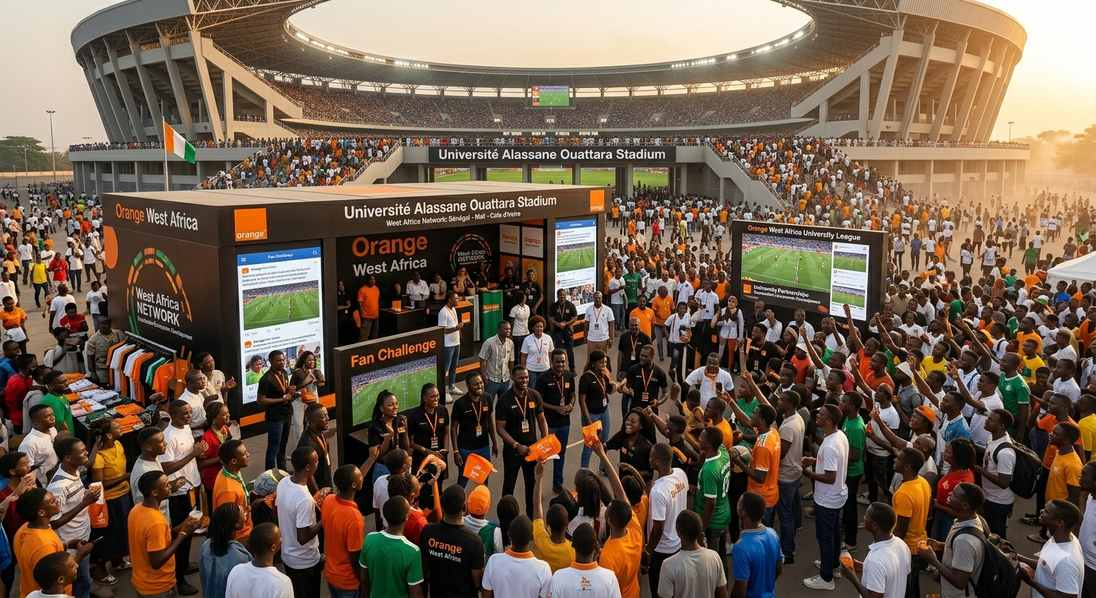
The commercial conversation in Ivory Coast begins with an unusual advantage: the brands most likely to sponsor the platform already know the platform.
The multinational organisations with the largest marketing budgets operating in Ivory Coast, telecommunications companies, FMCG brands, fintech platforms, consumer electronics brands, are the same organisations that have evaluated or activated the collegiate sports proposition in Nigeria. The commercial pitch in Ivory Coast is not an introduction to an unknown product. It is the extension of a known model into a market where those brands are already actively spending.
This is not a soft commercial assertion. The IMF’s 2025 projections place Ivory Coast’s real GDP growth at 6.5% for the period, the fastest in ECOWAS, with private investment rising consistently under the National Development Plan. The brands allocating pan-African marketing budgets are doing so in the context of Ivory Coast’s documented economic momentum. They are not asking whether to be in this market. They are asking what the most efficient, credible, and differentiated channel to the youth demographic looks like.
University sport is that channel. And a university sports platform that arrives having already operated in Nigeria, with documented commercial delivery, institutional relationships, and a founding legacy in HiFL’s professional athlete pipeline, does not need to make the case for the concept from scratch. It needs to show that the model applies here. The data above makes that case.
The World Cup Window and What It Creates
The timing of this expansion relative to the 2026 World Cup is not coincidental, and it is worth naming explicitly. Ivory Coast is at the World Cup for the first time in twelve years, drawn in Group E against Germany, Ecuador, and Curaçao, playing its opening match on June 15th in Philadelphia. The commercial attention on Ivorian football in June and July 2026, from global sponsors, from broadcasters, from professional clubs scouting African talent, is at a level that has not existed since 2014.
According to Pulse Sports Nigeria, the expanded 48-team World Cup format is actively widening scouting shortlists beyond established European-based players: “A serious 2026 World Cup scouting plan will include smaller leagues, not only stars already known in Europe.” That same logic applies to university football, and to the structured competition environments that create the documented performance records scouts are now actively seeking from African markets.
A platform that enters Ivory Coast in this window, as the World Cup amplifies international interest in Ivorian football and the scouts, agents, and clubs watching it look for the pipeline that produced the current generation and will produce the next, is entering at precisely the right moment.
Ivory Coast’s squad at the 2026 World Cup is valued at over €515 million. The players in that squad began somewhere. The platform being built now is where the next generation begins.
How the Platform Enters: The Same Discipline, Applied Here
The sequencing that governs how HiSL enters every market does not change in Ivory Coast. Governance alignment is secured before institutions are engaged. Institutions are confirmed before commercial conversations open. Nothing is announced before the framework that makes the announcement meaningful is in place.
In practical terms, that means engaging the relevant governing bodies across football, rugby, athletics, and basketball simultaneously, building the multi-sport institutional coalition that reflects the actual breadth of Ivory Coast’s university athletic culture. It means working within the governance frameworks that Ivory Coast’s sports institutions have built over decades, not arriving with a model designed elsewhere and asking the market to accommodate it.
It means being patient in the places where patience builds something durable, and moving quickly in the places where the market is ready to receive. Ivory Coast, on the evidence set out above, is ready in the ways that matter most: economically, commercially, institutionally, and, with the World Cup providing the most significant cultural amplifier Ivorian football has had in over a decade, at precisely the right moment in the market’s own sporting narrative.
The governance-first approach is not the fastest route to a press release. It is the only route to a platform that the market’s institutions will trust, the commercial partners will invest in, and the student athletes will compete in with the confidence that what they are joining is real.
The Pilot Phase: Three Markets, One Platform Argument
Nigeria, Ghana, and Ivory Coast form the pilot phase of a platform whose long-term vision extends across the continent. They were chosen not for geographic convenience but because each offers a distinct and complementary proof point for the model.
Nigeria is the founding market, the proof of concept built through HiFL’s operational legacy across multiple seasons, producing a documented cohort of professional athletes who are now competing across multiple continents. Ghana brings established university sports infrastructure and an international competition credential that shortens the institutional entry conversation. Ivory Coast brings the multi-sport institutional depth, the Francophone broadcast corridor, and the World Cup commercial window.
Together, these three markets cover West Africa’s largest economy, the continent’s most internationally credentialed West African university sports ecosystem, and the gateway to the Francophone West African commercial and broadcast corridor. When the platform operates across all three simultaneously, pan-African sponsors access three distinct markets through one commercial framework, one contract, one activation model, one reporting structure. That efficiency is not available to any platform operating in a single country or a single sport.
According to the World Bank’s 2025 Country Overview, Ivory Coast’s economy reached 6% real growth in 2024 and is the leading economic hub of ECOWAS. The GSMA’s Mobile Economy Africa 2025 report places mobile technology contributions to the African economy at $220 billion in 2024, with the continent’s youth population driving subscriber growth. The commercial and digital infrastructure for a university sports platform to operate and distribute in this market is not hypothetical. It exists.
The platform is not building into a future that might arrive. It is building into conditions that are already present. The pilot phase is not the ceiling of what this becomes. It is the foundation of it.