
What 120+ Universities Taught Us About Building Sports Platforms
Platform building. Talent pipelines. Student engagement at scale. Here is everything we learned.
Most sports organisations build for one team, one city, or one season. We built for 120+ institutions simultaneously, across two conferences, six geopolitical zones, multiple sporting disciplines, and a student population running into the millions.
When HiFL launched in 2018 as the flagship competition of the Higher Institutions Sports League (HiSL), the ambition was clear: create Africa’s most structured collegiate sports ecosystem, modelled on what the NCAA has built in the United States and BUCS has built in the UK. What we could not fully anticipate was what 120 universities would teach us about what a platform actually needs to work.
This is that story. It is also a blueprint for anyone thinking seriously about institution-led sports infrastructure in the developing world.
The Complexity Nobody Warns You About
Managing one football club is hard. Managing a league of 10 clubs is harder. Managing a competition across 120 universities, each with its own administration, its own academic calendar, its own sporting infrastructure, its own student politics, and its own relationship with sport is an entirely different discipline.
When PACE Sports and Entertainment Marketing signed the founding Memorandum of Understanding with the Nigerian University Games Association (NUGA) in February 2018, we were entering a space with no direct precedent on the continent. The NFF had not structured the collegiate tier. The NUC had not standardised how universities ran sport. There was no shared data layer, no common fixture format, no unified volunteer framework.
We were not just building a league. We were building the infrastructure for a league that had never existed, inside institutions that had never been asked to operate as a network.
The first lesson came quickly: 120 institutions do not behave like 120 individual actors once you give them a shared identity. They begin to behave like a network. And networks, once activated, have a logic of their own.
Lesson One: Governance Cannot Be an Afterthought
The single most critical early decision was to build governance infrastructure before competition infrastructure. In most Nigerian sports contexts, governance follows competition, rules are written after disputes arise. We deliberately reversed that sequence.
Local Organising Committees
Every participating university operates through a Local Organising Committee (LOC). This is not a rubber stamp. The LOC is the formal interface between HiSL’s national structure and the specific realities of each campus, including representatives from the institution’s sports management, the students’ union, security services, medical services, and the school’s press office.
The minimum composition requirement for an LOC is non-negotiable. This means that before a single game is played, every campus has embedded the competition into its administrative structure. The match is not an event that happens to a university, it is an event the university owns and operates within a nationally defined framework.
The Executive Management Board
Above the LOC layer sits the Executive Management Board (EMB), the statute-setting governing authority for HiFL regulations. The EMB defines the basic principles and detailed rules of governance, specifies the duties and powers of all bodies, and handles disputes that cannot be resolved locally.
This two-tier model, local ownership within national standards, proved to be one of the most scalable decisions we made. When operating across 100 institutions with enormous geographic and administrative diversity, you cannot centralise every decision. But you can centralise standards.
Conference Structure
HiFL divides institutions into two conferences: the Sahel Conference (northern states) and the Coastal Conference (southern states). This geographic structure reduced travel costs, created genuine regional rivalries, and allowed fixture scheduling to scale without centralising all operations. See the full conference breakdown on Wikipedia for the detailed zonal structure.
The lesson: governance structure determines scale capacity. Build it right at the start, and the platform can absorb more institutions. Build it poorly, and every new institution added creates new coordination costs.
Lesson Two: Standard Formats Create Shared Stakes
One of the most counterintuitive lessons from operating at scale is that standardisation does not reduce excitement, it creates it. When every university plays under the same rules, in the same format, with the same officiating standards, the results become genuinely meaningful. A win at Bayero University Kano carries the same weight as a win at the University of Lagos. The currency is shared.
HiFL’s competition format evolved from the inaugural 2018 season, 16 universities, 30 games, 14 weeks, to a mature structure with 32 teams playing 66 games over 21 weeks, through group stages, regional qualifiers, a Round of 16, Quarter-finals, Semi-finals, and a Final Four at a neutral venue.
In 2018, UAM Tillers won the inaugural HiFL title at the Lagos Agege Stadium. The format that produced that final had been stress-tested through 28 earlier games. Every team in the competition knew exactly what they needed to do to reach that stage. Standard formats are what make narratives possible.
The format also enables data integrity. When every match follows the same structure, performance data becomes comparable. Scouts, institutions, and the league can make meaningful assessments. You cannot build a talent pipeline without comparable performance data, and you cannot generate comparable data without standardised formats.
Lesson Three: Data and Reporting Systems Are the Platform
In HiFL’s early stages, the most undervalued operational element was data. Not broadcast data, operational data. Which institutions had submitted LOC rosters. Which players had cleared academic eligibility. Which fixtures had confirmed venue availability. Which officials were certified for which zones.
Across 120 institutions, each of these data points exists in a different format, held by a different person, with a different response time. Building a layer that aggregated and standardised this information was not glamorous work. But it was the work that made the league function.
Stanbic IBTC, which signed a long-term partnership with HiFL and remained committed from inception, required credible reporting on reach, engagement, and brand exposure. Sponsors do not renew based on goodwill, they renew based on data. The reporting infrastructure we built to serve institutional partners also created the accountability framework that kept universities engaged season after season.
The lesson: treat data infrastructure as a core product, not an operational cost. It is what allows HiSL to make credible claims to investors and partners, and to prove those claims with numbers, not anecdotes.
The Talent Pipeline: What Actually Happens to Players
The most visible output of a collegiate sports platform is the players it produces. For HiSL and HiFL, the talent pipeline is not a side effect of the competition, it is a core design principle. The competition exists partly to be seen by the people who need to see it.
The numbers, as documented across HiFL seasons:
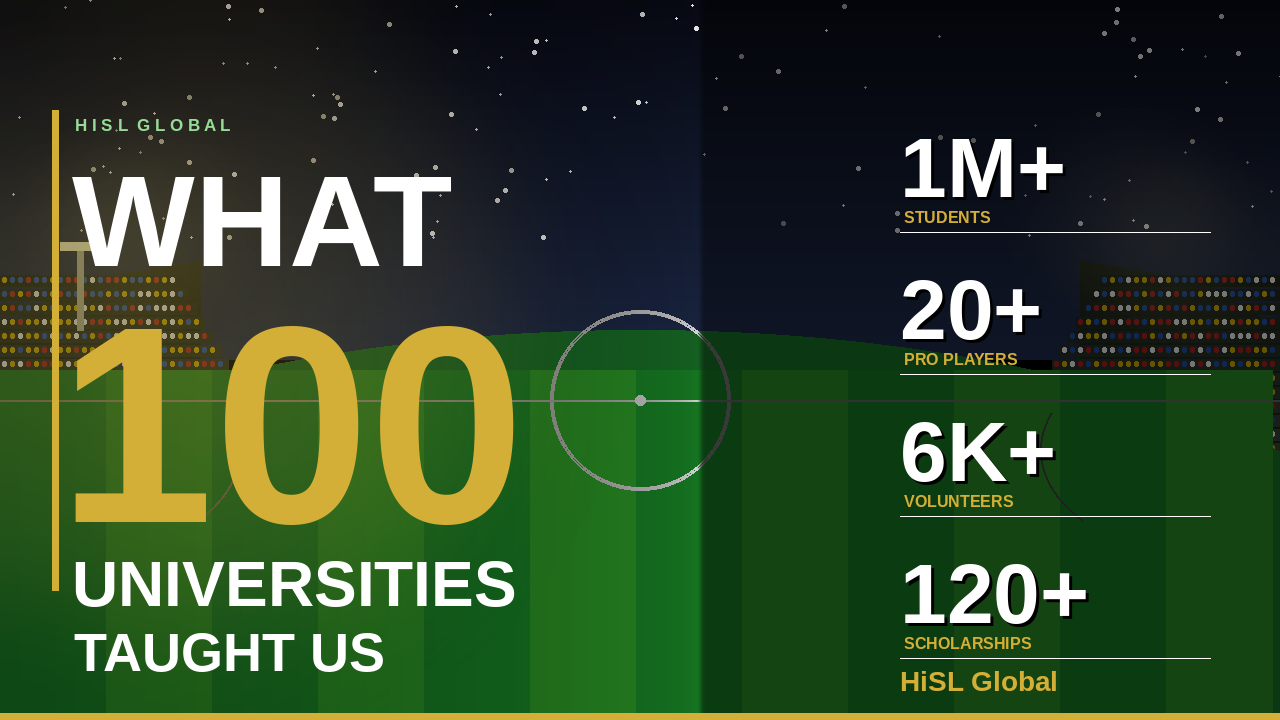
38+ players have transitioned to professional football leagues
120+ scholarships awarded to student-athletes by participating institutions
6,000+ volunteers recruited and deployed across seasons
1,000,000+ students reached across the HiFL platform
These are not marketing figures. Each professional pathway represents a player who was visible in a structured, nationally recognised competition, seen by scouts operating within a credible system. Each scholarship represents an institution that decided, based on athletic performance within a recognised league, to invest in a student-athlete’s future.
The NCAA’s model, which HiSL consciously studied, demonstrates that talent development at scale requires structured visibility, not just raw talent. Nigeria has always had the talent. HiSL’s contribution is the structure that makes that talent findable.
Why Campus Networks Create the Pipeline
University campuses are effective talent discovery environments for a straightforward reason: they concentrate 18-to-25 year olds with competitive drive and academic standing in a single institution. A scout attending a HiFL fixture is not reaching one player, they are reaching an entire squad, drawn from a student body of tens of thousands, pre-filtered through academic admission.
As HiSL expands its multi-sport model to include basketball, cricket, Esport, Rugby, crickets and etc mirroring what BUCS does across UK universities, the pipeline multiplies across disciplines. More sports mean more visible athletes across more institutions.
Student Engagement at Scale: How One Million Happened
The figure that draws the most consistent attention from partners is the engagement number: over one million students reached through the HiFL platform. It is worth being precise about what that means and how it was built.
Campus as Distribution Infrastructure
When a HiFL match takes place on a university campus, the distribution infrastructure is already in place. The students’ union promotes its membership. The institution’s communications office publishes fixtures. The LOC coordinates with campus radio and social media. A university campus is, in effect, a built-in media network with a captive and genuinely engaged audience.
This is the insight that underpins HiSL’s entire model: institutions are distribution. When you partner with 120 institutions, you inherit 120 distribution networks simultaneously. No amount of paid advertising reaches a campus audience the way a match that belongs to that campus does.
Volunteers as Engagement Multiplier
The 6,000+ volunteers recruited across HiFL seasons are not just an operational resource, they are an engagement channel. Each volunteer is a student with a meaningful stake in the platform. They are ambassadors within their campus communities, recruiting other students, creating content, and extending the reach of every event they participate in.
The principle is well-documented in international collegiate sport: volunteer participants report significantly higher levels of institutional loyalty and peer influence on attendance. The International University Sports Federation (FISU) has tracked this pattern across its member institutions globally. For a collegiate sports platform, this multiplier effect is fundamental to sustainable engagement.
Digital and Broadcast Extension
HiFL’s partnership with La Liga, which included the HiFL eINVITATIONAL, a virtual football league involving universities across Nigeria, demonstrated that the platform’s reach extends beyond physical attendance. Digital and broadcast distribution of campus sport, when the competition is structured and professionally produced, reaches student audiences who cannot attend in person.
One million engagements did not happen because HiFL advertised to one million students. It happened because 120 institutions each carried the platform to their own communities.
The Investor Takeaway: Platforms Scale Through Institutions, Not Individuals
The most important strategic insight from building HiFL and scaling it into HiSL is one that applies beyond sport.
Consumer platforms scale through individuals, one user at a time. Institutional platforms scale through organisations, one partnership activating thousands of individuals simultaneously. HiSL is an institutional platform.
When HiSL onboards a new university, it does not acquire one customer. It acquires a node in a network with an existing student body, an existing administration, an existing venue, an existing communications infrastructure, and an existing appetite for campus identity and pride. The marginal cost of adding each new institution is low. The marginal value, in reach, in talent exposure, in sponsor inventory, is high.
This is why the model scales in a way that consumer sports products typically cannot. A grassroots sports app acquires users one at a time. HiSL acquires institutions one at a time, and each institution brings thousands of users with it.
The Global Precedent
The two most successful collegiate sports platforms validate this thesis. The NCAA generates over $1 billion annually through institutional partnerships, broadcast rights, and sponsorship, built on university-level competition across hundreds of institutions. BUCS in the UK runs competitive sport across more than 170 member institutions, creating one of the country’s largest organised sports participation systems.
HiSL is building that model for Africa and the developing world, starting from a foundation that already has 120+ universities, 1,000,000+ student engagements, and a proven talent pipeline. Not a blank page. Visit hislglobal.com to see the platform roadmap.
Conclusion: What Comes Next: From HiFL to HiSLGlobal
HiFL was the proof of concept. HiSL is the platform.
The Higher Institutions Sports League unifies football, basketball, cricket athletics, Rugby etc into one structured ecosystem. The same governance model, the same LOC framework, the same data infrastructure, the same institutional partnership logic, now deployed across five sports disciplines and an expanding continental footprint.
The competition format is proven. The institutional relationships are live. The talent pipeline is already producing professional athletes and scholarship recipients. The volunteer and engagement infrastructure is already at scale.
What HiSL adds is multi-sport depth, expanded institutional coverage, and a commercial model built for the realities of Africa’s sporting economy, where youth population is the asset, campus density is the distribution network, and structured competition is the product that brands, broadcasters, and partners want to be associated with.
Champions are not born. They are built, inside institutions, through structured competition, with real governance, real data, and real stakes. That is what 120 universities taught us. And it is what HiSL is now teaching the rest of the developing world.