
The Student Athlete Nobody Scouts; Why West African University Sport Is Losing Talent Before It’s Found

There is a player at a West African university right now who is good enough to represent their country.
They wake up early. They train before lectures. They compete in a university competition with no cameras, no commentary, no data trail, and no way for the outside world to see what they are capable of. The pitch they train on barely has markings. The boots they wear cost more than their weekly budget. The season they play in ends without a record.
And then it is over. They return to their studies. The world moves on. Nobody who could have changed their life ever knew they existed.
This is not the story of one player in one country. It is a story being repeated, simultaneously, across university campuses in Nigeria, Ghana, Ivory Coast, Senegal, and beyond, across the full breadth of a subcontinent that produces some of the most gifted athletes on the planet and has built almost no institutional infrastructure to make them visible. It is a structural failure. And it is the failure that HiSL is built to end.
There is a player at a West African university right now who is good enough to represent their country. Nobody is watching.
The Talent That Goes Unseen: A West African Structural Failure

West Africa produces elite athletes at a rate that is disproportionate to the institutional infrastructure available to identify and develop them. The subcontinent’s professional football ecosystem, the Ghana Premier League, the Nigeria Professional Football League, the diaspora network of West African players competing across Europe, the Middle East, and Asia, is built on talent that, in most cases, was found despite the system rather than because of it.
University sport sits at the most critical and most neglected point in that pipeline. Between the ages of 17 and 24, an athlete either enters a structured environment that accelerates their development and creates visibility for their ability, or they disappear. Not because they lack talent. Because nobody with the infrastructure to see them was looking.
This is not a Nigerian problem. It is not a Ghanaian problem or an Ivorian problem. It is a West African problem, and it has the same structural cause in every market it appears in.
What Unstructured Competition Actually Means
Unstructured university sport is not the absence of competition. Universities across West Africa play matches. Students compete. Teams win and lose. What is absent is everything that makes competition commercially and institutionally legible to the outside world.
No consistent production:
no cameras, no footage, no match archive that a scout in Europe, an academy director in Accra, or a federation technical staff member in Abidjan can access the week after a fixture.
No data infrastructure:
no player statistics, no performance metrics, no season records that a national team coach can reference when building a selection shortlist.
No broadcast presence:
no platform through which student athletes become recognisable, develop a public profile, or attract the institutional attention that converts talent into a career.
No commercial context:
no structured season, no named fixtures, no competition framework that gives sponsors and academies a predictable occasion around which to build scouting operations.
What exists, in the absence of all of these things, is a talent pool of extraordinary depth spread across an entire subcontinent, functionally invisible to every institution that has the resources to develop it.
38 professional athletes produced by HiFL, HiSL’s founding platform in Nigeria, now compete in Hong Kong, Spain, Saudi Arabia, Scotland, Kosovo, and the CAF Champions League. From one market. One platform. Five seasons.
That number, produced by a platform with limited broadcast reach, operating in a single market, is the clearest possible illustration of what structured university sport unlocks when it is built correctly. HiSL’s expansion across West Africa is designed to replicate and multiply that proof point across Ghana, Ivory Coast, and beyond. The talent pool has not changed. The infrastructure around it is arriving.
What Structured Competition Changes: Visibility Is Infrastructure
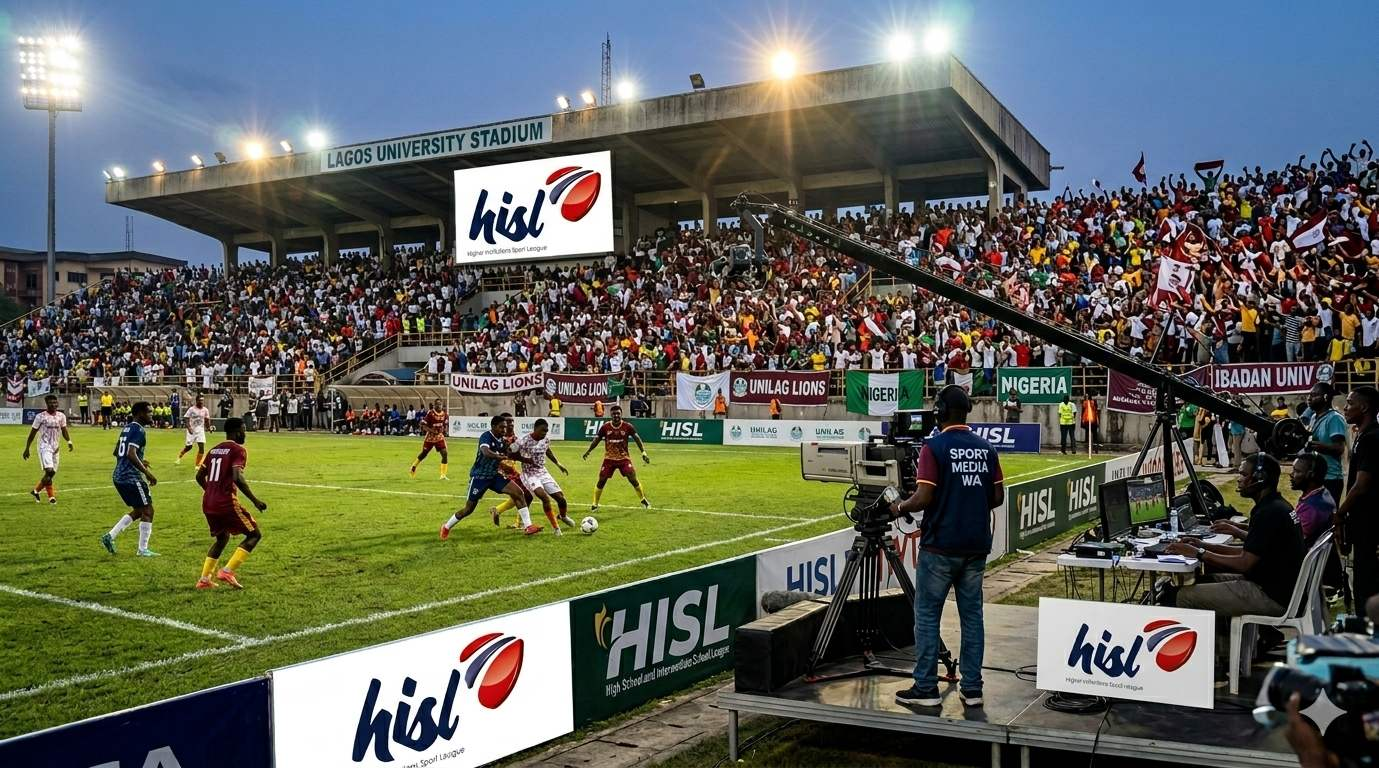
The difference between a talented athlete being seen and not being seen is not the quality of their performance. It is the quality of the infrastructure around their performance.
When a league has production, commentary, structured social media coverage, a genuine season format, and a broadcast partner, talent becomes visible. Not metaphorically visible, literally visible, on screens, in highlights packages, in social media clips that travel from student phones across professional networks at zero distribution cost.
How the HiSL Model Creates Visibility Across the Subcontinent
The HiSL season structure is built around three phases of competition, group stages, cluster finals, and a National Final, each of which generates distinct content moments, each of which creates a new occasion for a student athlete to be seen by someone who can change their trajectory. As HiSL’s phased expansion introduces participating institutions in Ghana and Ivory Coast, that same structure extends to new markets, producing the same scouting-ready, broadcast-supported competition record for student athletes across the subcontinent.
A goal scored in a group stage fixture in Accra is captured on camera and distributed on social media. A standout performance in a cluster final in Abidjan attracts the attention of scouts who have never visited that campus. A player who performs consistently across an entire season, with statistics, with footage, with a documented record, becomes as legible to a professional academy in Europe as any player who came through a more visible pathway.
This is what HiFL demonstrated in Nigeria across five seasons. The 38 professional athletes it produced did not emerge from a formal talent identification programme. They emerged from a competition that made them visible. The scouts who found them did not need to be told they were good. The footage told the story.
The Social Media Layer: Distribution at Subcontinental Scale
West Africa has one of the most active and demographically young social media ecosystems on the planet. According to GSMA projections, Sub-Saharan Africa will contribute 25 percent of all new global mobile internet users between 2025 and 2030. The infrastructure to distribute student athlete footage, highlights, and season narratives is expanding at exactly the rate at which HiSL is building the content to fill it, across Lagos, Accra, and Abidjan simultaneously.
Every rivalry matchday in the HiSL calendar is a social media event before it is a broadcast event. Student networks carry the content to audiences that no paid distribution campaign could reach as efficiently, and every view is a potential scout, a potential agent, a potential opportunity that a player in an unstructured competition would never have had.
Basketball’s Role in the West African Talent Story: The Pipeline Nobody Talks About

Football carries the headline across West Africa, as it does everywhere on the continent. But basketball carries an equally important talent story, and it is a story that the regional sports infrastructure has not yet told at scale.
West Africa’s basketball culture is real, it is growing, and it is globally connected. The NBA has invested deeply in the continent through the Basketball Africa League, through the NBA Academy Africa programme, and through a sustained commitment to identifying and developing the pipeline of African basketball talent at the professional level. That investment has already produced results, West African-born players compete at the highest levels of the global game, and the talent pool that feeds them continues to expand.
University basketball is the grassroots layer that feeds that pipeline. It is where a player with professional potential first develops in a structured team environment, first competes against peers at the same level of development, and first becomes visible to the coaches and scouts whose attention can accelerate a career. And it is precisely the layer where structured competition is most absent and most needed, not just in Nigeria, but across Ghana and Ivory Coast too.
HiSL as Structured University Basketball at Subcontinental Scale
HiSL is one of the few platforms currently offering university basketball at structured, multi-institution, multi-country scale across West Africa. The season structure features named basketball rivalries across regional clusters, each carrying the same production and broadcast infrastructure as the football competition, each generating the same scouting-ready footage and performance data.
A basketball player competing in the HiSL season, whether in Lagos, Accra, or Abidjan, is not playing in a tournament that disappears after the weekend. They are competing in a season with a group stage, a cluster final, and a path to the National Final, a documented record of performance across months of structured competition. That record is what professional scouts need and what informal competition, across the entirety of West Africa, currently cannot produce.
The NBA Africa’s investment in West African basketball development has proven that the talent exists across the subcontinent. HiSL’s university basketball platform is the structured grassroots layer that makes that talent findable, at scale, across borders, for the first time.
What Scouts, Academies, and National Teams Across West Africa Actually Gain

A structured league with real data, real footage, and real season results is more useful to a national team technical director, in Abuja, Accra, or Abidjan, than any informal scouting network operating across the same geography. This is not a sentiment. It is a logistics fact.
Informal networks produce recommendations. Structured competitions produce evidence. A technical director making a selection decision for any West African national team does not need to be told that a player is talented. They need footage. They need performance data across multiple fixtures at a consistent level of competition. They need a season record that can be reviewed, compared, and challenged, and that exists independent of whoever recommended the player in the first place.
The Scouting Infrastructure Argument
HiSL is not just a competition. It is a scouting infrastructure for West African university sport, a platform designed from the ground up to produce the documented, broadcast, data-supported player record that makes talent commercially and institutionally legible across an entire subcontinent.
Every HiSL matchday produces footage. Every season produces statistics. Every cluster final and National Final produces a high-visibility occasion where the players who perform under pressure do so in front of cameras, in a context that the professional sports world, across Europe, the Middle East, and beyond, can access and verify.
For a scout based in Europe, the proposition is direct: instead of coordinating separate trips to campuses in Lagos, Accra, and Abidjan that may or may not have matches scheduled, they access a season’s worth of footage for every participating institution across the full West African network from a single platform. The cost of talent identification drops. The confidence in the quality of what is identified rises. The geographical barrier that has kept West African university talent invisible to the professional world is removed.
For Academies: The Pre-Professional Pipeline Across Borders
Football and basketball academies across West Africa and beyond are in competition for the same narrowing pool of pre-professional talent. The institutions that identify and develop the best athletes earliest win. HiSL’s university season is the pre-professional layer, the competition environment where a player at 19 or 20 proves they can perform consistently, under pressure, in a structured format, against peers of comparable quality from across the subcontinent.
An academy director who builds a relationship with the HiSL platform gains access to a curated, broadcast-verified talent pool spanning institutions in Nigeria, Ghana, and Ivory Coast, across multiple sports simultaneously. That is a subcontinental scouting advantage that no informal network, operating in any single market, can replicate.
For National Federations: The Data Foundation West African Football Has Been Missing
The most underdeveloped resource in West African football and basketball talent identification is not scouts, it is data. National federations across the subcontinent operate talent identification processes that rely heavily on informal networks, academy recommendations, and diaspora-pathway players. The university system, which contains the largest concentration of athletic talent in every West African country at exactly the right developmental age,is structurally underrepresented in that process, in Nigeria, in Ghana, and in Ivory Coast equally.
HiSL changes that by producing what informal systems across the entire subcontinent cannot: a documented, broadcast, statistically supported record of every student athlete who competes in the season. Federations aligned with the FISU framework, and national bodies working toward continental recognition, gain an additional advantage: a competition platform whose governance structure is designed from the ground up to be compatible with international university sport standards.
A technical director with access to that record does not need to rely on what they have heard. They can review what they can see. And what they can see spans Lagos, Accra, and Abidjan simultaneously.
HiSL is not just a competition. It is the scouting infrastructure that West African university sport has never had; and the subcontinent’s talent pipeline has always needed.
Every Matchday Is a Talent Showcase. Every Season Builds the Subcontinental Pipeline.
The player at a West African university who is good enough to represent their country, the one training on the barely-marked pitch in Lagos, the one competing in an unseen fixture in Accra, the one whose talent has never been captured on a single frame of footage in Abidjan, is not a hypothetical. They exist right now, on campuses across the subcontinent, in their hundreds.
The HiSL season is the infrastructure that gives them a stage. A structured competition. A broadcast platform. A documented performance record. A scouting-ready format that makes their talent legible to every professional institution, on the continent and beyond, with the capacity to develop it further.
The 38 professional athletes that HiSL’s founding platform produced in Nigeria, now competing in Hong Kong, Spain, Saudi Arabia, Scotland, Kosovo, and the CAF Champions League, were found because a platform existed that made them visible. HiSL’s West Africa expansion brings that same model to Ghana, Ivory Coast, and beyond, rebuilt at greater scale, with greater broadcast reach, and with a deeper commercial and institutional structure than anything West African university sport has previously seen.
The talent was always here. Across the entire subcontinent. The infrastructure is arriving.
Note for Scouts, Academy Directors, and Development Partners
This article is part of HiSL Global Sport’s West Africa expansion communications strategy. It is designed to reach talent identification professionals, sports development investors, national federation technical staff, and brands aligned with youth development, across Nigeria, Ghana, and Ivory Coast simultaneously.
HiSL’s talent development argument is not theoretical. The 38 professional athletes produced by HiFL, the founding platform in Nigeria, are the documented proof that structured university sport in West Africa creates professional pathways for players who would otherwise have gone unseen. HiSL’s phased expansion across the subcontinent is built on the same governance-first, production-led model, extended now to Ghana and Ivory Coast, with further West African markets to follow.
Scouts, academy directors, national team technical staff, and development partners across West Africa interested in building a relationship with the HiSL platform should contact the team at partnerships@hislglobal.com or visit hislglobal.com.