Why University Sport Is Entering a New Era in West Africa

Across Africa, conversations about football almost always begin in the same place. Professional clubs. National teams. The academies feed both. The scouts arrived from European clubs and Gulf organisations, watching quietly from the stands, writing names into notebooks or typing them into databases before boarding the next flight.
That is where attention lands. That is where money flows.
Yet inside Africa’s universities, something else is happening entirely, something that does not usually make it into those notebooks, does not usually attract those scouts, does not usually find its way into the development conversations that shape the futures of talented young athletes. Every year, hundreds of thousands of young men and women arrive on campuses across the continent at the precise moment their bodies and minds are reaching peak athletic potential. Many have played organised football since they were children. Some have passed through academies and been told, by people who know the game, that they have something real. A handful have already drawn early professional interest.
But once they step through the university gates, most of them vanish from the formal development structures that should be tracking their progress and connecting them to the opportunities they have spent years working toward.
For decades, that has simply been accepted as how things work. University was where athletes went when the professional door had not opened yet, or had closed earlier than expected. It was not considered a development environment. It was a waiting room. A pause.
That reality is changing. And the forces driving the change are not small or isolated, they are structural, demographic, and converging in ways that are becoming impossible to ignore.
The Numbers Behind the Shift

Sub-Saharan Africa has the fastest-growing youth population on the planet. The World Bank projects that by 2030, the region will be home to more than 750 million people under the age of 25. Inside that extraordinary demographic reality sits an equally significant education story. University enrolment across sub-Saharan Africa has grown by more than 300 percent over the last two decades, according to UNESCO’s Global Education Monitoring Report, a rate unmatched anywhere else in the world.
Nigeria alone has over 170 accredited universities. Ghana’s university sector has expanded steadily across both public and private institutions. Ivory Coast has invested substantially in tertiary education infrastructure across Abidjan and its secondary cities. Across these three markets, the three pilot markets at the centre of HiSL’s expansion strategy, combined student populations are now measured not in hundreds of thousands, but in millions.
These are not abstract statistics. They describe where the athletes are.
The assumption has long been that talent development happens before university. In academies, in grassroots clubs, in national youth structures and regional trials. And that assumption is not wrong, those environments matter deeply, and the pathways they create are real. But they address one window of an athlete’s development. University is a different window. A longer one. One that runs deeper into physical and tactical maturity, that tests psychological resilience and competitive composure against peers who are equally advanced, that coincides with the years when the difference between a talented teenager and a professional footballer most often gets determined.
That window has been almost entirely ignored by the formal development ecosystem. It has remained largely disconnected from the structures, scouting networks, data systems, institutional investment, broadcast infrastructure, that give talent somewhere to go.
That is starting to look less like an oversight and more like an opportunity. And the organisations paying attention are the ones who will be best positioned when the infrastructure catches up to the scale of what is actually there.
When Talent Exists but Visibility Does Not
The gap is not about talent. That point cannot be made strongly enough, and it cannot be made often enough.
West Africa produces footballers at a rate that has attracted persistent global attention. FIFA’s development investment cycles have channelled substantial resources into African football infrastructure as part of the organisation’s broader commitment to growing the game across developing markets. CAF’s continental competitions continue to expand in both participation and commercial profile. European clubs and Gulf organisations are running increasingly active scouting operations through Lagos, Accra, and Abidjan, not occasionally, but as part of structured annual programmes.
The talent is there. The global interest in finding it is genuine and growing. What is missing is the infrastructure that makes talent visible, trackable, and connected to the people who have the resources and the mandate to act on it.
Structure is what turns a talented footballer into a documented athlete. Not just someone who plays beautifully on a particular afternoon, or who impresses in a trial that happened to be scheduled when a scout was available, but someone with a competition record built over months and seasons, a physical profile updated through proper monitoring, match footage from a real organised environment, and a developmental arc that clubs, national team technical staff, and institutional investors can actually assess.
That is what organised collegiate sports creates. Not just competition, a system of evidence.
HiFL demonstrated this directly, in a live Nigerian university environment. The platform organised university football with structured competition, documented athletes, and proper institutional participation. What came out of that system was not hypothetical. Players who competed inside that structure went on to professional careers in Hong Kong, Spain, Saudi Arabia, Scotland, and Kosovo. Others featured in the CAF Champions League. None of that was accidental. It was the direct result of an environment that connected talent to visibility in a systematic way, and gave the ecosystem a reason, and a mechanism, to take university athletes seriously.
HiSL is the scale version of what HiFL proved was possible. Multi-sport. Multi-country. Built with better data infrastructure and broader broadcast architecture. The proof of concept already exists. The question now is not whether this works, it is how far it can go.
The World Cup Is Changing What Everyone Is Looking For

The 2026 FIFA World Cup, running from June 11 through July 19, is already rewriting conversations about African football that have been conducted in the same terms for years. Some of those conversations have been overdue for revision for a long time.
Ten African nations qualified for this tournament. Ten. That is a record, and the significance of that number extends far beyond the matches themselves. It represents a structural acknowledgment, at the highest level of the sport, that African football has arrived at a different scale of global relevance. FIFA’s reinvestment of tournament revenue across its 211 member associations, confirmed by Gianni Infantino as part of the $11 billion economic footprint of this World Cup, reflects a commercial ecosystem that treats African football markets not as peripheral beneficiaries but as genuine growth engines.
Ghana is in Group L. Their campaign opens June 17 against Panama in Toronto, continues with England on June 23 in Boston, and closes against Croatia on June 27 in Philadelphia. Antoine Semenyo, who finished the Premier League season with 17 goals, is their most dangerous attacking threat. Jordan Ayew captains the side. The squad carries genuine ambition, and the attention it is drawing in Accra has the quality of something that spills beyond football into national conversations about identity, possibility, and what West African sport can become.
Ivory Coast arrived at this tournament with the highest-valued African squad in the competition. Transfermarkt values their roster at €515 million. Amad Diallo, 23, makes his World Cup debut having become one of Manchester United’s most important players in recent months. Franck Kessié brings 105 international caps of experience and leadership. Seko Fofana adds a layer of midfield authority that few African squads can match at this level. Their Group E campaign, against Ecuador, Germany, and Curaçao, will be watched across the continent with a level of sustained intensity that reflects how thoroughly this squad has captured the imagination of fans well beyond Ivory Coast’s borders.
Nigeria’s absence lands differently. Two consecutive World Cups missed. Daily Post Nigeria and Punch have both covered the structural and administrative dimensions of that failure at length, because this is not primarily a story about individual talent. Nigeria has produced some of the finest footballers of the past two decades, and the current generation continues that tradition. The issue is the pipeline. The system that should be converting that talent into a functional national team consistently enough to qualify for the world’s biggest tournament has not done its job.
That conversation, the one about why the talent exists but the structures around it do not, is the conversation HiSL is built to address. Not just in one market, but across all three.
Globally, the expanded 48-team format is changing how clubs approach talent identification. Pulse Sports Nigeria has reported directly on how wider participation is broadening scouting shortlists, drawing technical departments toward smaller leagues and overlooked markets that the old 32-team World Cup format gave them less reason to explore. West African collegiate sports is one of those overlooked markets. It will not be overlooked for much longer.
Football First, But Not Football Only
The framing of university sport as primarily a football conversation is natural and accurate. Football is the dominant participation and audience driver across all three of HiSL’s pilot markets. Any honest account of what makes university sport commercially and developmentally significant in Nigeria, Ghana, and Ivory Coast has to begin there, with the game that fills stadiums, defines national conversations, and produces the athletes that the global market most wants to find.
But the ecosystem is broader than football, and the argument for organising it is not sport-specific.
Basketball across West Africa is growing at a rate that reflects both global NBA influence and homegrown competitive development. The 3×3 game has particular penetration among younger urban demographics across Abidjan, Lagos, and Accra. Athletics has produced internationally competitive performers from West African university environments for decades. Rugby is growing steadily, with Rugby Africa’s sustained investment in player development across the continent beginning to create meaningful competitive depth in markets where the game had little formal infrastructure a generation ago.
Each of these disciplines benefits from exactly the same structural argument that applies to football. When athletes compete in organised environments with proper documentation, coaching frameworks, and institutional backing, the outcomes are better. Development is faster and more consistent. Visibility improves. The connection to professional and semi-professional pathways becomes real rather than theoretical.
The multi-sport architecture that HiSL is designed around is not a commercial diversification exercise. It is an acknowledgment that the talent pipeline in West African universities runs through more than one game, and that an infrastructure investment in organised collegiate sport returns value across multiple disciplines simultaneously.
The collegiate sports model, which has demonstrated sustained effectiveness in creating athlete development pathways across multiple sports in markets where it has been systematically invested in, adapts to the West African context with considerable relevance. The population base is there. The institutional infrastructure is there. The athlete talent is there. The question has never really been whether the raw material exists. It has always been whether the structure existed to do something meaningful with it.
Why Commercial Attention Is Following
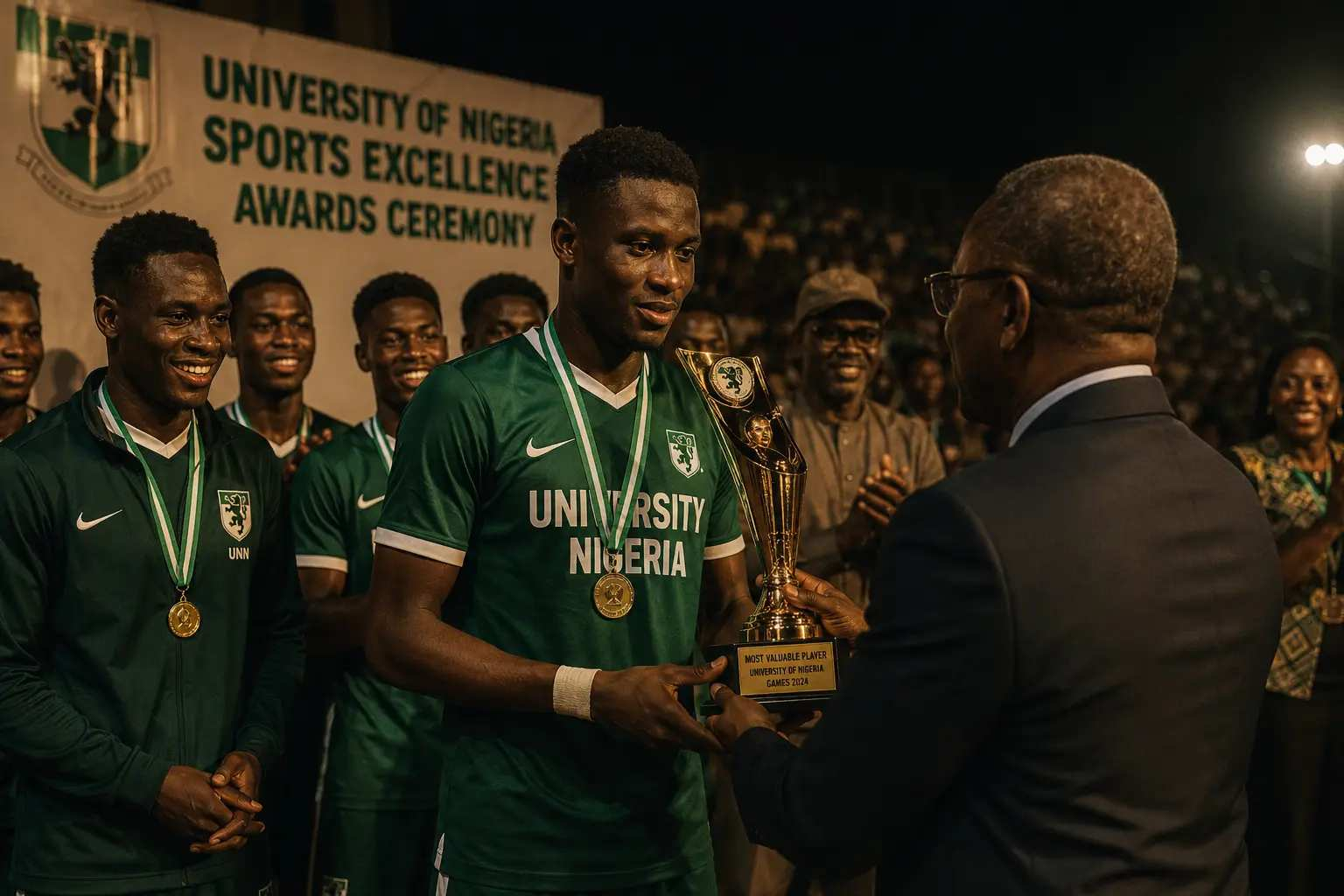
There is a reason that the most interesting conversations about sports investment in Africa are increasingly touching the university sector. It is not sentimental. It is commercial.
The demographic profile of the collegiate sports audience across West Africa, 18 to 28, digitally active, aspirational, already deeply engaged with sport at a personal and cultural level, is precisely the profile that pan-African brands in telecoms, fintech, and fast-moving consumer goods are chasing with increasing urgency and increasing precision. GSMA’s West Africa connectivity data shows mobile internet penetration continuing to rise across the region’s youth population, creating distribution and engagement infrastructure that simply did not exist for the previous generation of sports rights conversations.
WARC’s analysis of the 2026 World Cup advertising market places Africa, Latin America, and MENA as the markets with the highest viewing intensity per capita globally. The $10.5 billion injected into the global advertising ecosystem by this tournament is not evenly distributed, it concentrates in the markets where audiences are watching most intensely, which are not the established Western markets but the newer, younger, faster-growing ones. West Africa sits squarely in that picture. University sport sits squarely inside that audience.
For institutional investors exploring African sports infrastructure, the development finance institutions, the emerging market equity funds, the multi-club operators who have spent the last five years building positions across European football and now want exposure to earlier-stage talent ecosystems and commercial growth markets, the university layer is becoming harder to ignore. The World Bank’s broader data on African economic development provides the macroeconomic foundation. The demonstrated commercial potential of properly organised collegiate sports provides the investment narrative. The two are converging in 2026 in the three markets where HiSL is building.
Founding Partner positions on the HiSL platform are category-exclusive. Campus Activation Partner positions close when filled. The commercial logic is self-contained. The athletes are already competing. The question for brands and investors is simply whether they want to be inside that ecosystem when it becomes formally structured, or outside it, watching.
What Has Already Been Proved
None of this argument rests on theory alone. The case for West African university sport does not depend on projections or potential, it rests on what was actually built, and what it actually produced.
HiFL ran organised university football in Nigeria. Real competition. Real athletes. Real institutions participating on the record. The professional players it produced are not talking points in a development pitch, they are people who are currently competing professionally in multiple countries across multiple continents. They came through a university sport structure. They were visible because the structure made them visible. They moved into professional environments because the system gave professional environments a reason to watch them.
HiSL is not a reinvention of that story. It is the evolution of it, broader in sport, wider in geography, more sophisticated in data infrastructure, and built with the understanding that what worked in one country and one sport can work across three countries and multiple disciplines simultaneously.
The new era in West African collegiate sport is not arriving because someone imagined it would be valuable. It is arriving because the conditions that make it viable are finally all present at the same time. The population is there. The institutions are there. The digital infrastructure is improving fast enough to make broadcast and documentation viable at scale. The commercial interest from brands and investors is real and growing. The global football market is paying closer attention to West African talent than it has at any point in the sport’s history.
And the athletes, the ones who have been training and competing and developing without the infrastructure to make any of it visible, have been waiting long enough.
The future of university sport in West Africa will not be built by athletes alone. It will require institutions, investors, commercial partners, and sports stakeholders who understand what is possible when talent meets structure at scale. Follow HiSL as we continue exploring the forces shaping the new era of collegiate sports across West Africa.
To discuss brand partnership and sponsorship opportunities for the 2026 HiSL season, contact the HiSL partnerships team at partnerships@hislglobal.com or visit hislglobal.com/partners.