
The Missing Layer in African Football Development
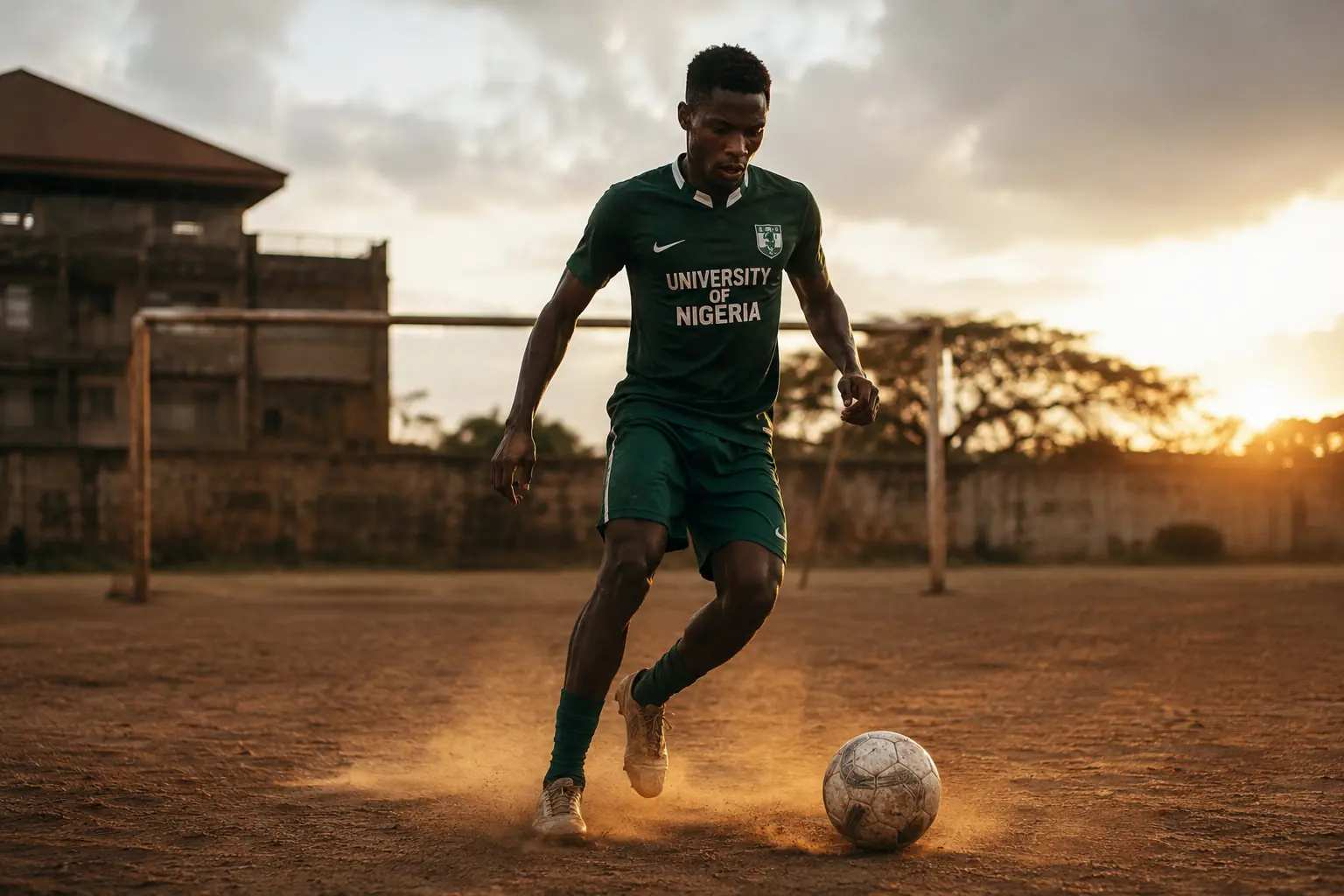
Every year, they arrive.
Thousands of them. Young footballers stepping onto university campuses across West Africa carrying everything they have spent the last decade building, the instincts sharpened in dusty neighbourhood matches, the technical habits reinforced through early academy training, the competitive edge developed in school competitions and regional trials, the physical attributes that coaches have told them, with varying levels of certainty, give them a real chance at something more.
Some of them have already been watched by scouts. A few have been told, by someone whose opinion carries weight, that they have a genuine future in the game. They arrive at university not because football is over, but because the timing of the professional door and the timing of their academic lives have not yet aligned, or because a parent insisted, or because one opportunity closed before another one opened, or simply because they are 18 years old and university is where 18-year-olds go.
Campus life begins. The lectures. The adjustment of building a new social world from scratch. The negotiations between who they have been as footballers and who they are now becoming as adults. Football continues, of course it continues, because for these players football is not a hobby and never has been, but the competitive structures that once provided visibility, consistency, and developmental momentum often do not come with them.
No organised competition that the professional ecosystem respects. No performance data being collected by anyone with a reason to analyse it. No footage from a real structured environment. No one formally tracks their progress over the months and years that happen to coincide with their most important window of physical and tactical development.
They are there. They are playing. They are improving, in many cases dramatically. And from the perspective of the professional football ecosystem that should logically be interested in them, they do not exist.
This is not a small problem. It is one of the most persistent structural failures in African football development, and it has been hiding in plain sight.
The Gap That the Development Pipeline Pretends Is Not There

African football’s development conversation tends to move in one direction. It starts at grassroots level, community pitches, neighbourhood clubs, the early identification programmes that are increasingly common across Nigeria, Ghana, and Ivory Coast. It moves through academies, where the most physically gifted and technically advanced players are selected and trained with increasing specificity. From there, the conversation jumps to the professional tier: the Nigerian top flight, the Ghana Premier League, the Ligue 1 Côte d’Ivoire, the European clubs with established African scouting networks.
Each of those stages is real and important. The conversation that moves through them is not wrong.
But there is a layer missing from that picture. A layer that contains, by sheer population size, more talented footballers than most academies across the continent will ever produce. A layer that occupies the precise developmental years, 18 to 24, when the difference between a talented academy graduate and a professional footballer most often gets determined.
That layer is the university.
The years between 18 and 24 are not simply a pause in athletic development. They are, in many cases, the years when physical maturity fully arrives. When a player who was quick and technically promising at 16 becomes physically powerful, positionally intelligent, and tactically sophisticated in ways that can only come with experience and biological development. When the psychological architecture of a professional footballer, the ability to perform under pressure, to lead, to recover from setbacks without losing competitive intensity, gets tested against peers who are equally advanced and equally motivated.
These are the years that matter most. And for the majority of talented footballers across West Africa, they happen inside an environment with no formal structure connecting them to the ecosystem that should be watching.
West African collegiate sports exists in a practical sense. Students compete. Rivalries develop between institutions. Matches are played on pitches where real quality is on display, week after week, without anyone from the professional game paying attention. But competition without structure is just activity. It does not produce the documentation that professional scouting requires. It does not create the longitudinal performance record that turns a talented player into a credible prospect. It is not visible, because it was never designed to be.
What the 2026 World Cup Is Revealing About Scouting
The conversation around talent identification has shifted perceptibly in 2026. The 48-team World Cup format did not just expand the tournament. It expanded the discussion about where elite football talent comes from, and, more pointedly, where it is being systematically missed.
Ten African nations at this World Cup. A record. When that number is compared against the continent’s share of the global youth population, against the depth of football participation across African communities, against the number of talented players that scouts and coaches across the continent will privately tell you are not in the system, the tournament becomes something more than a competition. It becomes a conversation about infrastructure. About who gets found, and why, and by what mechanism.
Ghana’s squad is drawing enormous attention for exactly the right reasons. Antoine Semenyo finished the Premier League season with 17 goals. Jordan Ayew captains a side that carries genuine expectation into Group L, against Panama in Toronto on June 17, England in Boston on June 23, and Croatia in Philadelphia on June 27. In Accra, the World Cup is not being watched as a spectator event. It is being watched as a conversation about what Ghana can be, what its players are capable of at the highest level, and what kind of structures produced them.
Ivory Coast’s squad tells a related story with a different inflection. The squad is valued by Transfermarkt at €515 million, the highest of any African team at this tournament. Amad Diallo makes his World Cup debut at 23 having become genuinely important at Manchester United. Franck Kessié arrives with 105 international caps and the kind of leadership presence that can only come from sustained exposure to elite football over a long period. Seko Fofana adds a quality in midfield that would be considered elite in any squad in the world. These players did not simply emerge. They came through developmental pathways that were organised enough to make them visible at the right moment.
The absence of Nigeria makes the structural argument with uncomfortable precision. Two consecutive World Cups missed. The talent has not disappeared. The players are there, competing in the Premier League, in European clubs, in academies, on university campuses. The pipeline that should be connecting them into a functioning national team has not done what it was built to do.
Daily Post Nigeria and Punch have both examined the administrative dimensions of that failure. But the structural dimension, the systematic disconnection between where the talent is and where the talent development infrastructure operates, is the deeper story. And it is not only a national team story. It is a West African collegiate sports story.
Pulse Sports Nigeria has reported directly on how the expanded 48-team format is widening scouting shortlists. Technical departments at clubs across Europe and the Gulf are being compelled to broaden their networks into markets and environments they previously had less reason to explore systematically. The overlooked university footballer in Lagos, Accra, or Abidjan is no longer purely hypothetical. He is the kind of player that widening shortlists are starting to ask about.
The Architecture of Visibility

Modern talent identification is not the same business it was ten years ago. The notebook still exists. Scouts still travel, still watch, still form instincts that no algorithm has yet managed to replicate. But the notebook is no longer sufficient on its own, and serious recruitment departments at serious clubs know it.
What professional clubs and national team technical staff increasingly require is information with depth and continuity. Not impressions from a single afternoon. Not the name of a player someone saw in a trial that happened to be scheduled when a scout was in the country. They need a competition record built from a structured environment, across a proper season, over time. They need footage that shows how an athlete performs consistently, under pressure, in high-stakes moments, not just on a good day. They need physical profiling data. They need the kind of longitudinal picture of an athlete’s development that can only come from a system with documentation built into its infrastructure from the beginning.
The established collegiate sports systems that have operated in other markets for decades have understood this architecture for a long time. The infrastructure built around university sport in those environments, the organised competition structures, the athlete databases, the media coverage that produces footage as a natural byproduct of normal operation, the professional scouting access built into the calendar, creates a direct and systematic pipeline between campus and professional level. That pipeline works because visibility was designed into it from the start.
West Africa has the athletes. What it has lacked is that architecture.
HiFL built a version of it in Nigeria, in a live university environment, with real institutions and real competition. The outcomes were direct and measurable. Players who competed inside that structure went on to professional careers in Hong Kong, Spain, Saudi Arabia, Scotland, Kosovo, and the CAF Champions League. Not as isolated success stories, but as a documented pattern of outcomes that emerged from a system that made athletes visible in the right way, to the right people, at the right time in their development.
Those outcomes were not accidents. They were the product of structure applied to talent that had always been present.
HiSL is that architecture at a wider scale across three markets, multiple sports, and an improved data infrastructure designed specifically to produce the kind of athlete records that modern scouting requires. The proof of concept is not theoretical. It happened. The question now is how widely that model can be replicated across West African collegiate sport.
What Proven University Sport Ecosystems Share
The collegiate sports model has a long history of producing professional athletes across multiple sports in markets where it has been systematically developed and properly resourced. What makes those systems work is not primarily the raw talent inside them, it is the structure built around that talent.
Structured competition means athletes are tested consistently, across a full season, against opponents of varying quality, in environments that simulate the pressure and consequence of professional sport. Not tested once in a showcase. Not observed in a trial with sixty other players. Tested continuously, in a format that produces a longitudinal record that tells a coherent story about who an athlete is and what they are becoming.
Scheduled seasons mean performance can be tracked over months and years. The player who is outstanding in September but inconsistent by March tells a different story from the player who builds through a season and finishes the year better than they started. That distinction, the difference between a flash of talent and a developmental trajectory, can only be observed over time. Sporadic competition cannot produce it.
Institutional backing means athletes have access to coaching, sports science, facilities, and academic stability simultaneously. The combination matters because the university years are not purely athletic years, they are years of competing demands, personal development, and the construction of an adult identity. Athletes who have proper support across that entire context develop differently from athletes who are navigating it alone.
When those structural elements are present, the talent identification outcomes change. Athletes become documentable. Documentable athletes become identifiable. Identifiable athletes become findable by clubs, agents, national team staff, and the commercial structures that benefit from knowing who the next generation of West African football talent actually is.
The West African university sector has the student population. It has athletes. It has, in Nigeria, Ghana, and Ivory Coast, a growing institutional infrastructure that is capable of supporting organised sport at a meaningful scale. What it has not had, in any systematic way, is the organised collegiate sports platform that connects those assets into something the development ecosystem can actually use.
The Player Who Should Not Have Disappeared

There is someone specific this is all for. Not a composite. Not a hypothetical character assembled to illustrate an argument.
There is a footballer on a university campus right now, in Lagos, in Accra, in Abidjan, who is better than most people around him have ever taken the time to acknowledge. He played academy football. He was identified early. He was told, at 14 or 15 or 16, by someone who had watched a lot of football, that he had something real. He went to university because the professional door had not opened at the exact moment his life required a decision, or because his family wanted the security of a degree alongside the uncertainty of a football career, or because a coach he trusted told him the development would continue and the opportunity would come.
He is still playing. He is still competing, with the same intensity he has always had. He understands the game at a level that his opponents, many of whom are also genuinely talented, consistently underestimate until they are on the pitch with him. He has developed the composure and tactical intelligence that only comes with a certain volume of competitive experience and a certain degree of physical maturity. He is, in objective terms, a better footballer at 21 than he was at 17.
Nobody from the professional ecosystem is watching him. Not because there is nothing to see. Because the environment he is competing in has no mechanism for producing visibility. No scout would know where to look. No footage exists from a consistent, structured environment. No competition record has been compiled. No one has been paid or commissioned to find him, because no one yet has a system that makes finding him efficient.
African football has lost generations of players to exactly this gap. Not because they were not good enough. Because the structure that should have made them visible was not built.
The gap is not abstract. It is a specific person, on a specific campus, competing this week in a match that no one outside that institution will ever know about.
Why 2026 Is the Year This Changes
The timing of this conversation is not arbitrary, and the convergence of forces making it possible to have it is not coincidental.
The 2026 World Cup has placed African football under a global lens at precisely the moment when structural questions about development pipelines are being asked more urgently, and more specifically, than they have been in years. Nigeria’s second consecutive absence has generated a genuine national reckoning, not about talent, but about infrastructure. Ghana’s presence in Group L and Ivory Coast’s arrival as the highest-valued African squad in the tournament have deepened public investment in football conversations across both countries at every level.
At the same time, the macroeconomic and demographic conditions in Nigeria, Ghana, and Ivory Coast are creating an environment where properly organised university sport is increasingly viable on commercial terms. University enrolment continues to rise. Digital infrastructure is improving. GSMA’s West Africa data confirms mobile internet penetration growing consistently among exactly the youth demographic that organised collegiate sport would reach. Brands are actively seeking environments with genuine, deep, consistent access to the 18 to 28 audience. Institutional investors exploring African sports infrastructure are beginning to ask better, more specific questions about where the development value actually sits.
The World Bank’s documentation of the regional demographic trajectory provides the macroeconomic foundation. UNESCO’s enrollment data confirms the institutional scale. The World Cup provides the cultural and commercial moment. And HiFL’s documented outcomes provide the proof that the model works.
The missing layer in African football development is not invisible anymore. The athletes have always been there. The universities have always been there. What is being built now is the structure that connects them, to each other, to the professional ecosystem, to the commercial infrastructure that will make the whole system sustainable over time.
That structure is what HiSL is.
The future of talent development in West Africa is not simply about finding better athletes. It is about building better systems around them. Follow HiSL as we continue exploring how university sport can become a stronger, more connected part of Africa’s football development story, and how collegiate sports across West Africa can finally reach the athletes who have been waiting to be found.
To discuss brand partnership and sponsorship opportunities for the 2026 HiSL season, contact the HiSL partnerships team at partnerships@hislglobal.com or visit hislglobal.com/partners.