
Why Structure Matters More Than Talent Alone
Ask anyone who has spent real time around West African football and they will tell you the same thing, usually within the first few minutes of conversation. Talent is not the problem. It has never been the problem.
Walk through a training ground in Kumasi on a Saturday morning, or a five-a-side pitch behind a market in Abidjan, or a university sports field in Lagos where students have improvised their own league with tape marking the touchlines, and it is immediately obvious. Feet that move with an economy most academies spend years trying to coach into a player. Instincts that cannot be taught, only recognised. A hunger that shows up in how hard a nineteen-year-old chases a ball he has no real chance of reaching, simply because giving up has never occurred to him.
Then the game ends. For most of them, so does the pathway.
Not because the ability disappeared. Because nothing was built to carry it anywhere beyond that pitch.
This is the uncomfortable truth sitting underneath almost every serious conversation about football development on the continent, and it applies just as directly to basketball, athletics, and every sport where West African competitors hold their own against anyone in the world. Countries do not run short of talented people. They run short of the systems capable of finding them, developing them, documenting them, and connecting them to opportunity before that window of possibility quietly closes.
Talent is a starting point. On its own, it has never been a guarantee of anything. What separates the athlete whose name eventually travels from the equally gifted athlete who disappears back into ordinary life is rarely a gap in ability. It is a gap in structure. Understanding that distinction, really understanding it, changes how an entire region should think about what comes next. HiSL was built to cover that gap.
The Myth of Talent Alone
There is a comforting story that gets told about talent, and it goes something like this: real ability finds its way to the top eventually. Cream rises. Somebody, somewhere, will notice.
It is a good story. It is also mostly wrong, and it has quietly done a great deal of damage to how African sport gets talked about, funded, and built.
Arsène Wenger, who has spent the years since leaving Arsenal running FIFA’s global football development programme and travelling to more academies and federations across the continent than almost anyone currently working in the sport, put it as plainly as it can be put. Speaking at an international coaching conference in Freiburg, he described the core problem in football’s global talent pipeline.

|
“Talent-spotting is not working well enough. We’re missing out on a lot of talent because we’re not able to identify them.” — Arsène Wenger, FIFA Chief of Global Football Development |
That is not a comment about the existence of ability. Wenger built his entire reputation on identifying exactly that, first at Monaco, then across two decades at Arsenal. It is a comment about infrastructure, about the machinery, or the persistent absence of it, that turns a gifted teenager playing on an unmarked pitch into a documented, trackable, scoutable prospect with a name attached to a record rather than a rumour.
Think carefully about what actually has to happen for a talented young footballer in Nigeria, Ghana, or Ivory Coast to be seen by someone with the power to change his trajectory. He has to be playing in the right match, on the one day a scout happens to be present, performing well enough in that specific ninety minutes to be remembered afterward, and then someone has to know how to find him again once the match ends and he disappears back into a city of millions. Multiply that improbable sequence by the thousands of informal matches happening every single weekend across three countries with a combined population edging toward 300 million people, most of them under twenty-five, and the scale of what is being missed becomes almost impossible to calculate honestly.
It is not a talent shortage. It is a visibility shortage. The two get confused constantly, because from the outside, a player who was never seen looks indistinguishable from a player who was seen and judged not good enough. The record shows nothing either way. That is precisely what makes the problem so persistent and so easy to misdiagnose. A federation or an investor looking at the absence of professional output can easily draw the wrong conclusion, assuming the talent simply was not there in the first place, when in fact nobody ever built a system capable of finding out.
This is where the myth of talent alone becomes actively costly, not just philosophically wrong but expensive in real, measurable terms. If everyone genuinely believed cream rises on its own, there would be no urgency to build anything. Scouts would keep doing what they have always done, trusting that eventually the right names would surface through word of mouth and lucky timing. But nobody who has studied how modern football actually functions still believes that, which is exactly why FIFA committed 200 million dollars to its Talent Development Scheme through the 2023 to 2026 cycle, why 176 member associations have already enrolled, surpassing FIFA’s own initial target, and why development officials keep returning to the same word whenever they are asked to diagnose the gap: infrastructure, not ability.
Talent alone gets an athlete a good performance on a good day. It has never, by itself, gotten anyone a career. What gets a career built is the structure sitting underneath the talent, quietly doing the work of noticing, tracking, and connecting that raw ability has never been able to do for itself, no matter how exceptional that ability is.
The Role of Organised Competition
If talent is the raw material, organised competition is the process that turns it into something with a verifiable shape. This is not a subtle distinction. It is the entire difference between an athlete who can be properly assessed and one who can only ever be described secondhand.
Picture two versions of the same gifted nineteen-year-old midfielder. In the first version, he plays for his university on an ad hoc basis, in matches that follow no consistent calendar, against opposition of wildly varying quality, officiated inconsistently, with no footage kept and no record beyond word of mouth passed between friends. He might be extraordinary. Nobody outside his immediate circle has any real way of confirming it, and nobody with resources to invest has any reason to take the claim seriously.
In the second version, that same midfielder plays inside a structured competition with a fixed season, standardized rules, consistent officiating, and matches that follow each other in a pattern a scout, an agent, or a data analyst can actually study over time. Suddenly he has a body of work. Ten matches. Twenty. A goals record. A minutes-played record. A pattern of performance against opponents of known quality, in conditions that can be compared across a season and measured against athletes competing in other structured systems elsewhere on the continent or beyond it.
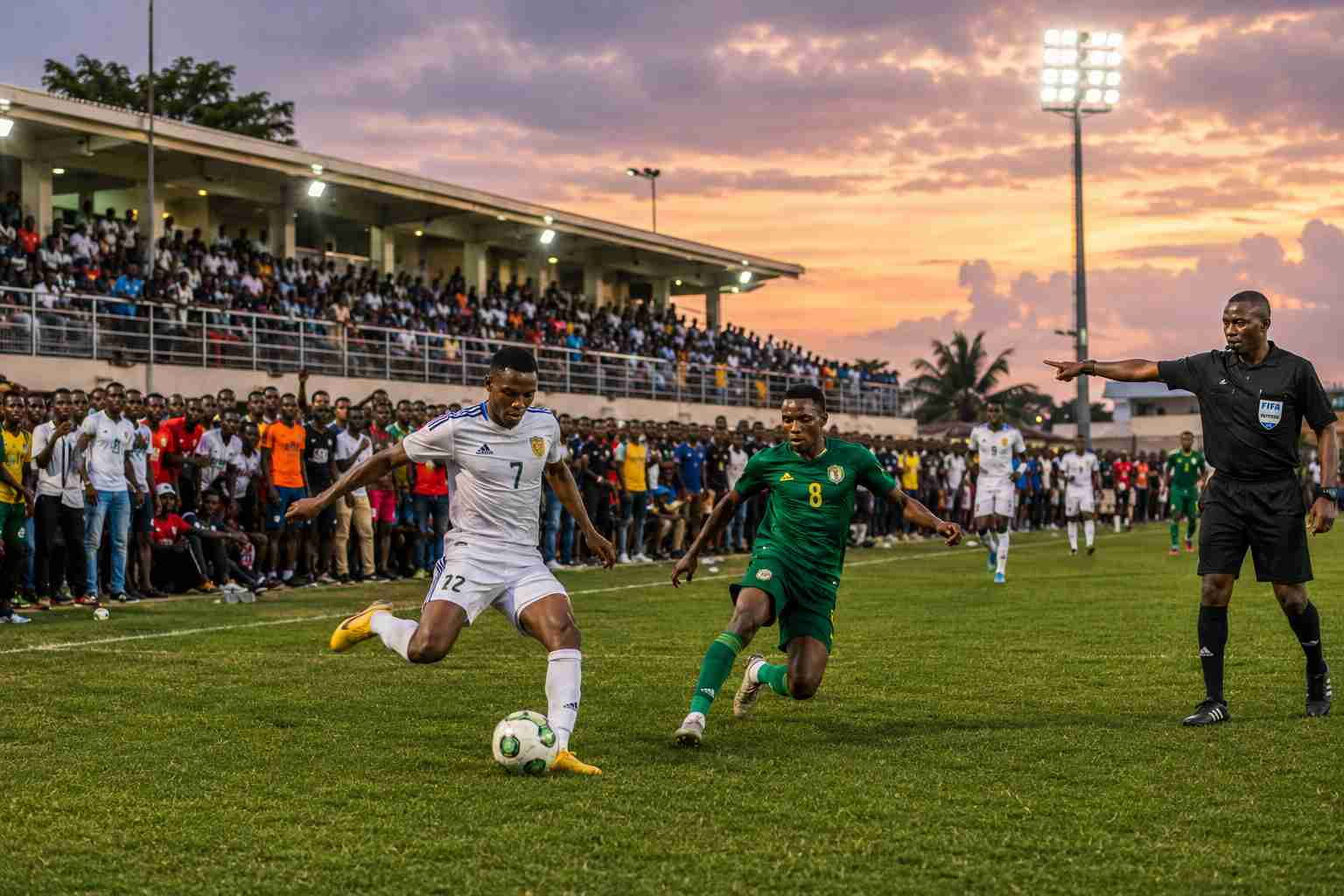
The player has not changed in either version. What has changed is whether the world can see him clearly, and whether what it sees can be trusted.
This is why organised competition matters so much more than it appears to at first glance. It is not simply about giving athletes something to play in, though that matters in its own right. It is about creating the conditions under which ability becomes legible, comparable, and trustworthy to the people who hold the resources to act on it. A club scout cannot build a recruitment case around “he looked good the one time I happened to see him.” He can build a case, and defend it to a technical director asking hard questions, around a season-long record inside a competition whose structure and standard he understands and trusts.
Organised competition also does something that visibility alone cannot: it develops the athlete. Consistent, high-level competitive minutes build a different kind of player than sporadic, unstructured matches ever could. Tactical understanding sharpens through repetition against varied opposition. Psychological resilience gets built through the accumulated pressure of a real season, with real stakes, rather than a handful of isolated matches. Physical conditioning improves under a schedule designed to build and sustain form, rather than the feast-or-famine rhythm of occasional, unpredictable games. By the time a scout does arrive to watch a structured competition, the player being assessed is measurably further along than he would have been without it.
CAF President Patrice Motsepe made the connection between structural investment and outcome directly, after nine of Africa’s ten qualified nations reached the round of 32 at the 2026 World Cup, a record for the continent.
|
“Hard work and investments in youth football, coaching, professional leagues and infrastructure in each of the 54 CAF member associations is bearing fruit.” — Patrice Motsepe, President, Confederation of African Football |
It is worth sitting with what that sentence actually claims. Not that Africa suddenly discovered a greater volume of talented players between 2022 and 2026 than it had before. That the structures built deliberately around an already-existing pool of ability, sustained over years of patient investment in coaching, youth systems, and competitive infrastructure, produced a measurably different and better outcome from broadly the same underlying talent base.
Ghana reached the World Cup knockout stage for the first time since 2010, advancing to the round of 32 before a narrow defeat to Colombia, on the back of a settled squad, a clear tactical identity under coach Carlos Queiroz, and the kind of consistent competitive rhythm that only comes from a properly structured qualifying campaign. Ivory Coast, fielding the highest-valued squad of any African nation at the tournament, also advanced into the knockout rounds before their own run concluded. Neither result happened by accident, and neither was primarily a talent story. Both were the product of federations, coaching structures, and competitive pathways deliberately built over years, applied to ability that, in truth, had always been there.
The same underlying logic applies at every level below the senior national team, all the way down to university sport. A structured collegiate sports competition, run to a consistent format across a full season, does for a nineteen-year-old university footballer exactly what a well-run national federation does for a senior international squad: it creates the conditions under which performance becomes evidence, rather than remaining anecdote that nobody outside the immediate campus community will ever verify.
Data, Documentation, and Visibility
Modern sport, at every serious level, runs on information. Not sentiment, not reputation, not the secondhand word of someone who once saw a player have a good afternoon three seasons ago. Information: match minutes, performance data, physical profiles, competition records, verified footage, a documented history that can be checked, compared, and trusted by someone who has never watched the athlete play in person and likely never will.
This is the layer that determines whether talent, once it exists inside an organised competition, actually travels anywhere beyond the boundary of that competition. A brilliant season played inside a well-structured league still needs to be properly documented to matter to anyone outside that league’s immediate audience. Without documentation, even genuinely strong performance data dissolves back into the same anecdotal fog that swallows undiscovered talent everywhere, no matter how organised the competition producing it actually was.
Consider what has already happened to football scouting globally over the past decade. Recruitment that once depended almost entirely on a scout’s eyes, instincts, and personal network now runs alongside performance databases tracking measurable outputs across leagues most casual fans have never heard of. Clubs comparing an unfamiliar player in one market against a known quantity in another increasingly do it by comparing documented data profiles, not by hoping someone eventually finds the budget and the time to fly out and watch a match in person. The athletes who benefit most from this global shift toward documentation are, almost by definition, exactly the ones who were previously hardest to see: competitors operating outside the traditional pipelines that European and Gulf clubs already know and trust by default.
Makhtar Diop, Managing Director of the International Finance Corporation, framed the underlying opportunity in blunt terms during a discussion of Africa’s sports economy.

|
“With sports, you can change your society. You can turn your economy around.” — Makhtar Diop, Managing Director, International Finance Corporation |
That is not a comment about isolated moments of individual sporting brilliance, the kind that occasionally breaks through despite the absence of structure. It is a comment about what becomes possible once a sector builds the full infrastructure required to convert consistent talent output into consistent economic and developmental value, and documentation sits right at the center of that infrastructure. Without it, even a strong competitive structure only solves half the problem.
For a university athlete competing in Accra, Lagos, or Abidjan, none of this is an abstract global trend happening somewhere else. It is the direct, practical difference between remaining invisible and becoming properly accessible. A documented competition record, verified performance data, and consistent match footage do for a twenty-year-old collegiate athlete exactly what they do for a seasoned professional: they replace “I heard he’s good” with something a decision-maker on another continent can actually evaluate on its own merits and act on with confidence, without ever having set foot anywhere near the pitch where the performance happened.
This is also where the audiences that matter most to the future of West African collegiate sport all converge on the same underlying need, whatever their individual motivations. Institutional investors want documented traction before committing capital to an unfamiliar market. Club owners and multi-club operators want verifiable performance histories before making recruitment decisions that carry real financial risk. Commercial brands want measurable audience engagement before signing sponsorship agreements they can defend internally. University administrators want credible competition data before building institutional identity and investment around it. Scouts and academy directors want trustworthy, comparable records before recommending a player to a club that will stake real money on that recommendation. Broadcasters want a properly documented, consistently produced product before committing distribution and production resources to carrying it. Every one of those relationships, regardless of which audience is asking, depends on the same foundational layer: information that can be trusted because it was properly built, properly kept, and properly maintained over time rather than assembled after the fact.
Lessons from HiFL’s Legacy
None of what has been argued so far is theoretical for anyone who watched what actually happened inside Nigerian university football between 2018 and its final season.
HiFL did not create talented athletes. Nigeria’s universities were never short of ability, before HiFL existed or after it wound down. What HiFL built, deliberately and over seven consistent seasons, was the structure sitting underneath that already-existing talent: a standardised competition format, a fixed and reliable season calendar, a documented record of performance across every participating institution, and an environment credible enough that scouts, agents, and eventually professional clubs began paying serious attention in a way they simply had not before the platform existed.
The results were not incremental. They were the direct, visible output of what happens when real structure gets applied to talent that was already present and simply waiting to be organised around. Players who competed inside that structured environment went on to professional careers in Hong Kong, Spain, Saudi Arabia, Scotland, and Kosovo. Others featured in the CAF Champions League, the continent’s most prestigious club competition. None of those athletes became more talented on the day they signed those contracts. What changed, over the course of their university careers, was that a system had made their ability visible, documented, and trustworthy enough for a professional club, often thousands of miles away, to act on it with genuine confidence rather than a leap of faith.

That is the entire lesson, distilled into a single sentence: structure does not create talent, it unlocks the opportunity that talent was always capable of earning, if only someone had built a way for that opportunity to reach it.
It is worth being precise about what HiFL actually was and was not, because the distinction matters for understanding what comes next. It was never a talent factory manufacturing ability that did not previously exist on Nigerian campuses. It was an operating system, a competition framework, a documentation layer, and a credibility engine, all built deliberately around ability that had been sitting largely unseen for years before the platform arrived to organise it. Seven seasons of consistent delivery, season after season without interruption, is precisely what turned that credibility from an unproven claim into an established track record that clubs and scouts came to rely on.
HiSL is the scale version of exactly that same founding principle, applied more broadly than any single university league ever attempted before. Multi-sport, rather than confined to football alone. Multi-country, rather than confined to a single national footprint. Built with a stronger data and documentation architecture from the very outset, learning directly from what HiFL proved and what it revealed still needed to be improved, and designed with a broadcast footprint capable of reaching further than any individual university league ever could on its own. The underlying logic has not changed even slightly. Structure remains the variable that determines whether talent becomes opportunity or simply fades quietly with each graduating class. What has changed is the ambition of how far that structure now reaches, across Nigeria, Ghana, and Ivory Coast simultaneously, and across football, basketball, volleyball, athletics, and beyond in a single, coherent system.
The athletes competing across university campuses in all three of those countries right now are not waiting to become talented. They already are, in exactly the way generations of West African athletes before them already were. What they are waiting for, whether they would ever describe it in these precise terms or not, is a structure capable of doing for them what HiFL already proved could be done for an earlier generation: turning ability that already exists into a record that travels, a season that gets watched and remembered, and a pathway that leads somewhere real rather than dissolving quietly the moment the final whistle of a university career blows.
The Bottom Line
The countries that eventually build the strongest sporting economies in the world will not be the ones that happened to produce the single most gifted individual athlete of a generation. Nearly every country produces gifted individual athletes; it is one of the more evenly distributed things about human potential, scattered across geography without much regard for which nations have built the infrastructure to notice it. The countries and platforms that win, over the long run, are the ones that build the structure capable of finding that talent early, developing it properly through consistent competition, documenting it honestly, and carrying it all the way to the opportunity it has always deserved.
West Africa has never had a talent problem. Nigeria, Ghana, and Ivory Coast between them have produced some of the finest footballers this sport has ever seen, alongside basketball players, sprinters, and athletes across a dozen disciplines who compete with anyone in the world on any given day. What the region has lacked, at the university level specifically, is the structural layer capable of catching that talent early enough, and holding onto it long enough through organised competition and honest documentation, for it to matter to the people positioned to act on it.
That is not a talent gap. It has never really been a talent gap. It is a structure gap. And unlike talent, which either exists in an athlete or does not, structure can be deliberately built, one properly organised season at a time.
Become Part of the Structure
The future belongs to the systems that help talent become visible, measurable, and supported, not to the hope that raw ability will somehow find its own way through instinct and luck alone. HiSL is building that structure across Nigeria, Ghana, and Ivory Coast, applying the same operating principle that HiFL already proved works, now extended across more sports and more campuses than any single university league has attempted before.
Follow HiSL as we continue exploring how structure creates opportunity.
Institutions, governing bodies, and commercial partners who want to understand what HiSL’s platform means for their context should contact the HiSL partnerships team at partnerships@hislglobal.com or visit hislglobal.com/partners.