What Ghana’s World Cup Presence Says About West African Talent Development
World Cups often celebrate the finished product. The player lifting a trophy. The goalscorer under the lights. The breakout star on the global stage. Much less attention is paid to the systems that helped those athletes develop in the first place, the years of unglamorous repetition, the coaches nobody photographs, the competitive structures that quietly decided who got seen and who did not.
Ghana’s presence at the 2026 FIFA World Cup is worth examining through exactly that lens. Not because the Black Stars lifted anything in this tournament, they did not, but because the shape of their campaign, a team that punched, held its own, and exited on fine margins against sides with considerably more institutional football infrastructure behind them, is a near-perfect illustration of a country that has spent decades producing individual brilliance without ever fully building the system that brilliance deserves.
That distinction, between talent and the structure around it, is the entire argument of this piece. Ghana is not a case study in a country lacking football ability. It is a case study in what happens when a nation keeps producing world-class individual talent through informal and semi-formal channels, decade after decade, without the university-level development layer that would let that talent be documented, tracked, and converted at scale rather than by individual accident. HiSL opens the door.
It is worth being precise about what that word, accident, actually means in this context, because it is not a criticism of the players themselves, every one of whom earned what they achieved through years of work most fans never see. It describes the pathway that got them there. A scout happened to be at the right five-a-side pitch on the right afternoon. A coach at a local club notices a teenager’s technique and decides, on instinct, to push for a trial. A family connection to someone already inside professional football, opening a door that would otherwise have stayed shut. Every one of these routes has produced real talent. None of them is a system. A system does not depend on who happened to be watching on a given day.
Ghana’s Reputation as a Talent-Producing Nation
Few nations of Ghana’s size have produced the density of elite footballing talent that Ghana has across the past four decades. The lineage starts, in most conversations about Ghanaian football, with Abedi Pele, a three-time African Footballer of the Year whose influence on the sport in Ghana runs so deep that his own sons, Andre and Jordan Ayew, grew into senior internationals themselves, with Jordan captaining the very squad that competed at this 2026 tournament. That is not a coincidence of genetics. It is a small, visible example of how football knowledge and opportunity compound inside a family, and a hint at how much more talent might surface if that same compounding effect existed at a structural level rather than only within individual households fortunate enough to have it.
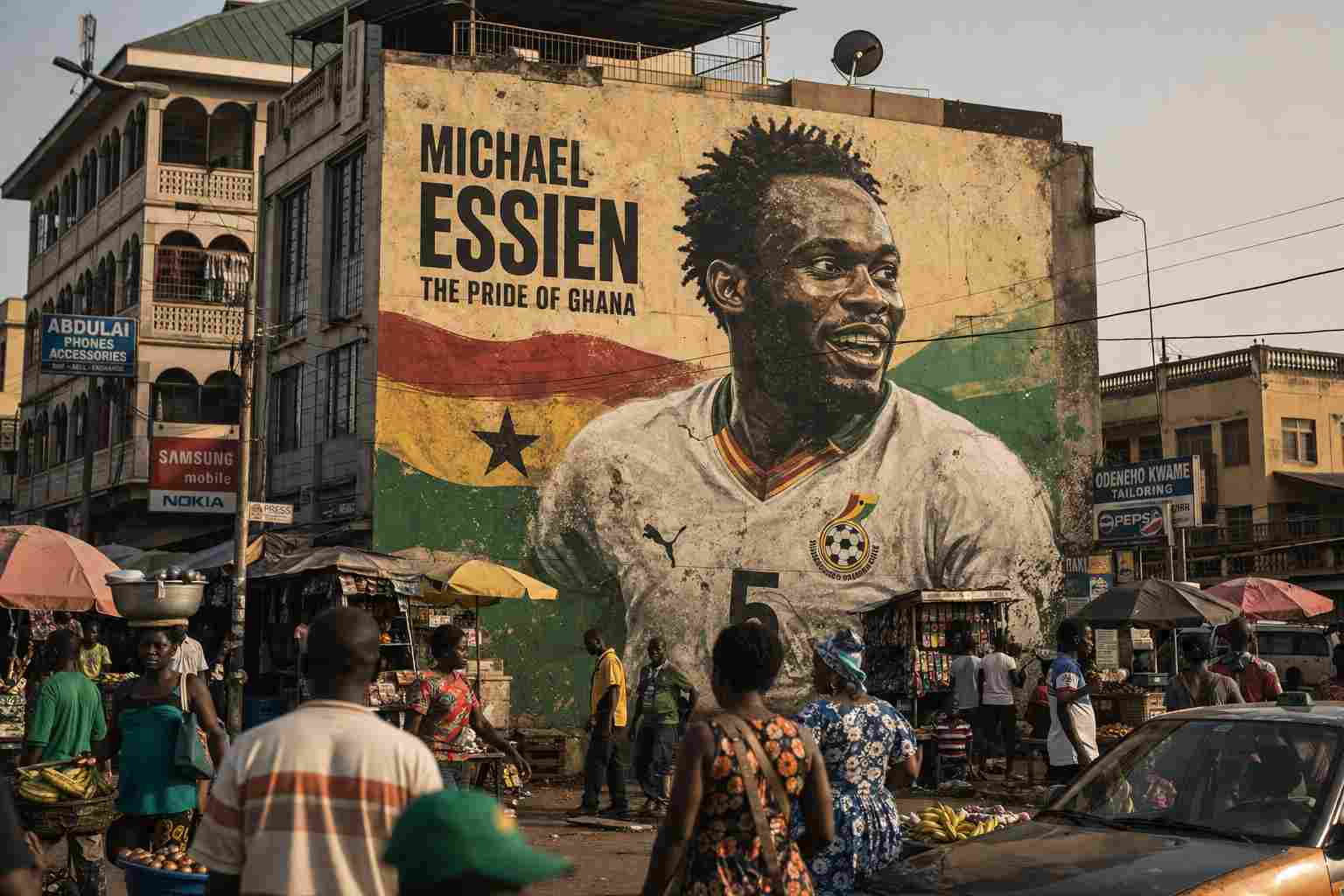
Michael Essien built a decade-long career at the highest level of European football, first at Chelsea and later at Real Madrid, recognised as one of the finest midfielders of his generation. Asamoah Gyan became the first African player to score at three separate FIFA World Cups, a record that speaks to the kind of sustained individual excellence Ghana has repeatedly produced. Sulley Muntari won a Champions League title with Inter Milan. Each of these careers followed a similar pattern: extraordinary individual ability, discovered and developed through a mix of club academies, informal street football, and no small amount of fortunate timing, rather than through any single, consistent, documented national pathway.
The current generation carries that same lineage forward, even if this particular tournament did not end the way Ghanaian fans hoped. Antoine Semenyo closed out the Premier League season with 17 goals, evidence that Ghana’s talent pipeline, whatever its structural gaps, is still capable of producing players operating at the highest club level in the world. Mohammed Kudus has become one of the more technically gifted attacking midfielders of his generation. Jordan Ayew’s captaincy of this squad closes a kind of generational loop that began with his father’s playing career decades earlier. None of these are stories about talent running dry. They are stories about talent continuing to surface, generation after generation, through a pipeline that has never been given the structural investment its output would justify.
That 2009 U-20 title remains one of the clearest pieces of evidence for what Ghanaian football is capable of when a generation of talent is given even a semi-structured competitive platform. It is still, more than fifteen years later, Ghana’s only FIFA World Cup title at any level. That gap, between a single golden generation’s peak achievement and everything that has followed, is not a talent problem. It is a pipeline problem.
Ghana’s 2026 campaign fits neatly inside that same pattern. A 1-0 win over Panama built on organisation and composure. A 0-0 draw against England that, on another day, could easily have gone Ghana’s way. A 1-2 loss to Croatia that still left them competitive enough on points and disciplinary record to advance as one of the eight best third-place finishers in a 48-team field. Their tournament ended in the Round of 32, a 1-0 loss to Colombia in Kansas City in the first days of July, the margin as fine as the ones that have defined Ghanaian football’s relationship with the World Cup stage for two decades.
Ghana has never lacked the players. What it has lacked is a system built to guarantee that the next Essien, the next Gyan, is found on purpose rather than by chance.
It is worth naming plainly what that gap has likely already cost. For every Essien, every Gyan, every Ayew whose talent found its way to a professional trial through whichever informal channel happened to be open at the right moment, it is reasonable to assume there were others, equally gifted, whose path never opened at all. Not because the ability was not there, but because nobody organised enough was watching when it mattered. That is not a statistic Ghana can currently measure, and that inability to measure it is itself the clearest evidence of the gap this piece is describing.
What Long-Term Development Actually Requires
Individual brilliance, however extraordinary, is not a development system. A system requires athlete pathways that are documented from adolescence through senior competition, competition structures that run consistently enough to generate real performance data rather than one-off trial impressions, educational environments that support rather than compete with an athlete’s training schedule, and institutional support substantial enough to keep a talented seventeen-year-old inside the pipeline rather than losing them to informal football, economic pressure, or simple invisibility.
Ghana has real pieces of this puzzle already in place, and they deserve genuine credit. Right to Dream Academy, founded in Ghana and later expanded through a $120 million investment from Egyptian businessman Naguib Sawiris’s ZED Sports network into a footprint spanning Ghana, Denmark, Egypt, and California, has become one of the most credible academy systems on the continent, sending graduates directly into European club structures. That is exactly the kind of institutional investment long-term development requires, rigorous, well-resourced, and built to last beyond a single sponsorship cycle.
But an academy system, however excellent, is still a narrow funnel. It identifies and develops a small number of athletes with the talent and, often, the family circumstances to be discovered early and placed inside a formal programme. It does not, and was never designed to, capture the far larger population of talented young footballers who did not pass through an academy trial at thirteen, who kept playing through their late teens on university and community pitches, and who are just as likely to produce the next Ghanaian midfielder capable of a decade in European football, if anyone is actually watching, and documenting, what they do.
There is a broader demographic context that makes closing that gap more urgent, not less. Ghana’s university sector has expanded steadily across both public and private institutions over the past two decades, part of the same regional pattern of higher education growth that UNESCO’s Global Education Monitoring Report has measured at more than 300 percent across Sub-Saharan Africa over twenty years. Every year that growth continues without a matching sport development structure inside it, more talented university-age footballers pass through Ghana’s higher education system undocumented, playing at a competitive level nobody outside their own campus ever sees.
That is the gap. Not a talent gap. A visibility gap, sitting precisely in the years between whatever informal or academy-based development a young Ghanaian footballer received as a teenager, and the moment, if it ever comes, when a club or national team scout happens to notice them playing somewhere organised enough to be worth watching twice.
Why University Sport Matters Within the Pathway
University is precisely the window where that gap sits, and precisely the window organised collegiate sport is built to close. The years between eighteen and twenty-three are not a pause in an athlete’s development, whatever the informal wisdom in West African football has historically assumed. They are years of continued physical maturation, tactical growth, and competitive hardening, the exact years in which a talented but previously undocumented player can either be found, or lost, depending entirely on whether the structure around them is organised enough to make their performance visible.
HiFL demonstrated precisely this in Nigeria between 2018 and 2023. Real university competition, properly documented, produced a cohort of professional athletes now playing in Hong Kong, Spain, Saudi Arabia, Scotland, and Kosovo, and others who featured in the CAF Champions League. None of those players needed an academy trial at thirteen. They needed a university sport structure serious enough to make their performance during their university years count toward something. HiSL’s expansion of that model into Ghana, as one of its three pilot markets, applies the exact same logic to a country whose talent-producing reputation is already firmly established and simply needs the structural layer that has been missing.
It is worth pausing on how directly this argument speaks to Ghana’s own historical near-misses. The 2009 U-20 squad that beat Brazil on penalties did not appear out of nowhere. Nine of the players who reached the 1993 U-20 final had already won a FIFA U-17 title two years earlier, evidence that Ghana’s youth pipeline, when it does connect properly, produces results at the very highest level. The question that has followed Ghanaian football for the sixteen years since 2009 is why that generation’s success was never systematically repeated. A university sport, running every season, in every one of Ghana’s major cities, is precisely the kind of structural repetition that turns a golden generation from a one-off into a pattern.
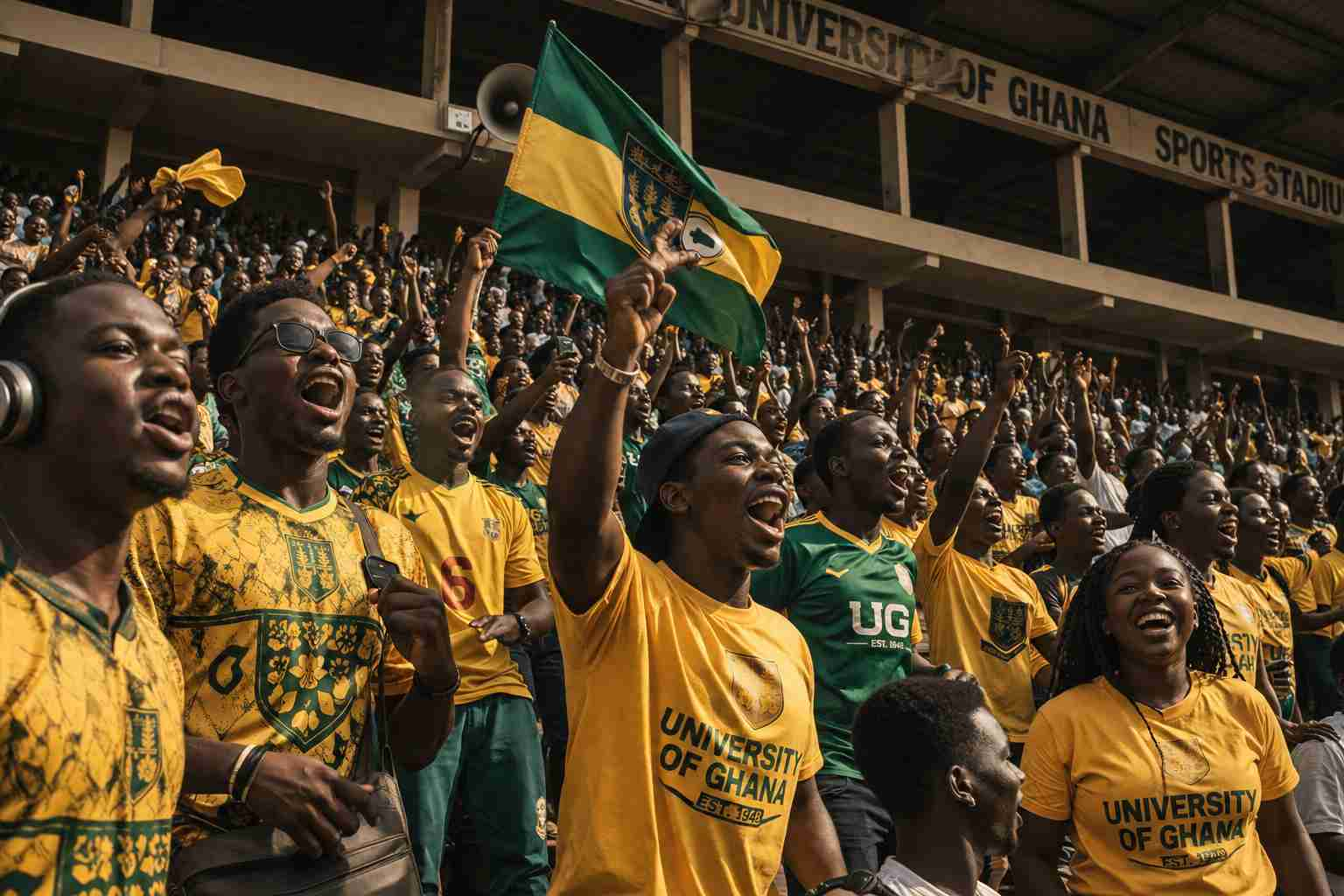
That a university stadium in Accra could already host a continental championship of that scale says something important about where the physical and organisational capacity for collegiate sports already sits inside Ghana. The infrastructure question is largely answered. What remains is the season-long, football-specific competitive structure that would let a university footballer in Kumasi or Cape Coast build the same kind of documented track record that a Right to Dream graduate receives through the academy system, without needing to have been discovered at thirteen to get it.
This is also where the collegiate sports argument connects most directly to Ghana’s football identity specifically. A country that already treats football as something close to a national language, and that has produced Abedi Pele, Michael Essien, Asamoah Gyan, and a World Cup-winning U-20 generation through channels considerably less organised than what university sport can offer, is not a market that needs to be convinced football matters. It is a market that needs the structural layer built underneath a passion for the game that has never once been in question.
The Broader Lesson for West Africa
Ghana’s story does not exist in isolation from its neighbours, and the wider 2026 World Cup cycle has made the regional pattern harder to ignore than it has ever been. Ivory Coast arrived at this tournament fielding the highest-valued African squad in the competition, built around Amad Diallo, Franck Kessié, and Seko Fofana, and still exited at the Round of 32. Nigeria did not qualify at all, a second consecutive World Cup missed, widely reported as a structural and administrative failure rather than a talent shortage. Ghana advanced further than either of its neighbours, and still ran into the same ceiling at the same stage.
Three different countries, three different World Cup stories, and the same underlying lesson repeated three times: talent is not the constraint.
That repetition matters. When one country’s football underperforms relative to its talent, the explanation might reasonably be specific to that country, a governance dispute, a coaching change, a single bad tournament. When the same pattern shows up across Nigeria, Ghana, and Ivory Coast in the same World Cup cycle, three countries with different football histories, different administrative structures, and different tournament outcomes, the more honest explanation is regional and structural. West Africa’s university years remain the least organised, least documented stretch of the entire athlete development pipeline, in every one of these three markets simultaneously.
That is precisely why HiSL’s pilot is built across Nigeria, Ghana, and Ivory Coast together, rather than as three separate, disconnected national projects. Ghana’s particular contribution to that regional story is its track record, decades of individual footballing brilliance that has never been matched by an equally serious domestic development system. A country that has already proven, repeatedly, that it can produce world-class footballers without a fully organised pipeline is a country where a properly organised one, layered carefully onto a football culture this deep, has every reason to produce considerably more than it already has.
Talent, in other words, was never the question in Ghana, or in Nigeria, or in Ivory Coast. The question has always been whether the structure exists to find it consistently, develop it properly, and give it somewhere real to go. University sport is the piece of that structure that has been missing for the longest, in the years that matter most, and it is the piece organised collegiate sport is built specifically to provide.
Ghana’s 2026 World Cup story will fade from headlines within weeks, the way every tournament’s non-champions eventually do. What should not fade is the pattern underneath it, a football nation that has spent decades proving what it can produce, still waiting for a development system built to match that output on purpose, every season, rather than once a generation, by chance.
Follow The Pathway
Talent may be universal, but opportunity rarely is. Follow HiSL as we continue exploring the systems that help athletes move from potential to possibility.
To discuss brand partnership and sponsorship opportunities for the 2026 HiSL season, contact the HiSL partnerships team at partnerships@hislglobal.com or visit hislglobal.com/partners.