How Africa’s Collegiate Sports Market Became One of the Most Attractive Untapped Commercial Spaces
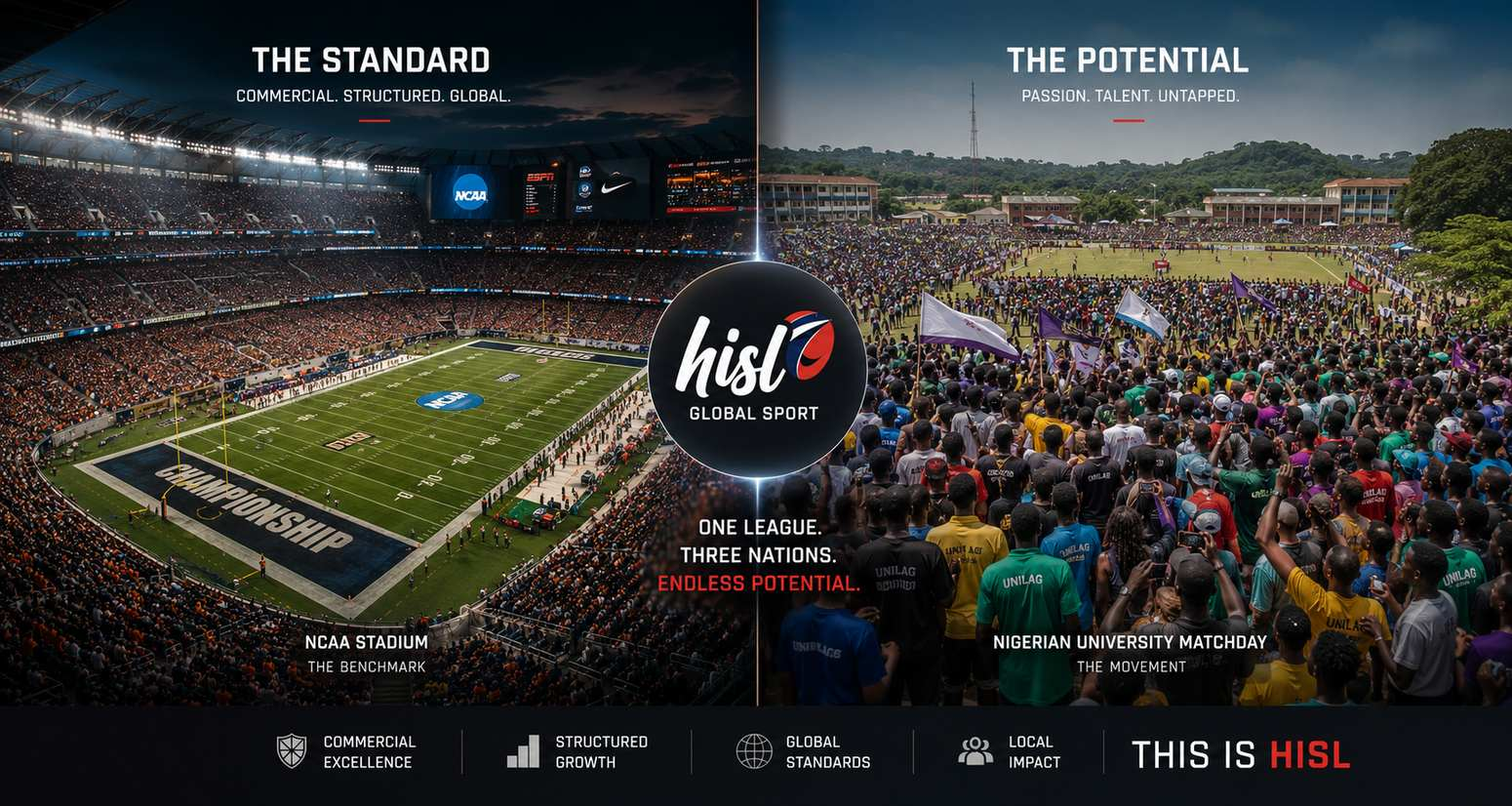
The NCAA Generates Over $1 Billion. BUCS Structures 160 Institutions. Africa Has 1,331 Universities and No Equivalent Platform Yet.
The NCAA generates over $1 billion annually from collegiate sport. According to Sportico’s audited review of its FY24 financial statements, the figure was $1.38 billion, with media partnerships with Turner and CBS alone contributing $873 million of that total. BUCS, the national governing body for university sport in the United Kingdom, structures competition across more than 160 institutions, with over 100,000 students competing annually across 850 national and regional leagues.
Africa has 1,331 officially recognised higher education institutions as of 2025, according to uniRank’s verified database. It has an enrolled student population exceeding 15 million and a demographic trajectory that will place one in every four people aged 15–24 on earth in Africa by 2030. It has extraordinary athletic talent, a mobile-first generation with brand-receptive spending habits, and a continent-wide passion for sport that fills stadiums without marketing budgets.
What it does not have, at any scale, in any market, is the commercial platform infrastructure to convert those inputs into institutional value.
That is the opportunity. That is the African collegiate sports investment thesis that HiSL is building into.
The Market Fundamentals: A Demographic Case That Writes Itself
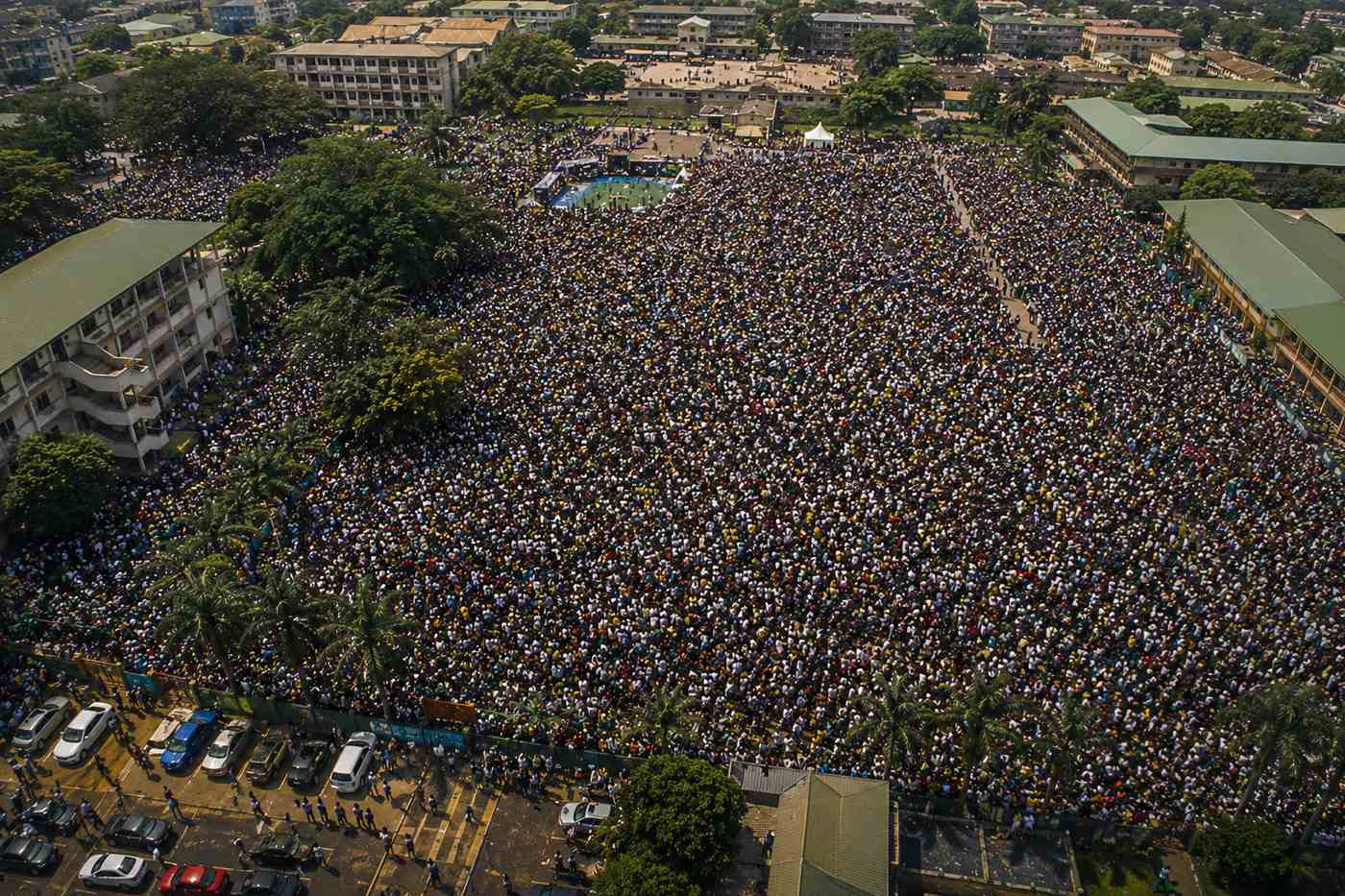
The foundational investment case for African collegiate sport does not require projection. It is already locked into population structure.
According to ICEF Monitor’s documented projections, total higher education enrolment across Africa is expected to triple from 7.4 million students in 2015 to nearly 22 million by 2040. The NUC has confirmed that Nigeria alone currently has more than 2.1 million students enrolled across its universities, over 1.8 million of them undergraduates in the core 18–26 demographic. These are not passive consumers. They are mobile-first, brand-receptive, socially connected, and concentrated in dense campus environments that make them the most efficiently reachable consumer demographic in the country.
The fintech sector already knows this. By the first half of 2025, Nigeria’s licensed mobile money providers had processed approximately ₦50 trillion in transactions, growth driven in large part by the 18–30 urban demographic that university campuses concentrate. PalmPay alone serves over 35 million registered users and processed 15 million daily transactions in Q1 2025. OPay reported over 50 million registered users and roughly $12 billion in monthly transaction volume. Both are competing aggressively for the same audience, the same campus demographic that HiSL has structured access to across 30 universities in 2026.
Telcos face the identical dynamic. Airtel, MTN, and their competitors are deploying field teams and marketing budgets to reach the same student population, in environments that, without HiSL’s platform infrastructure, generate high cost and low conversion.
The median age across Nigeria is 18.4 years. Across Africa broadly, it is under 20. This is not a demographic with a sports interest that needs to be cultivated. It is a demographic for whom sport is already the primary shared cultural currency, and for whom no structured, commercially packaged collegiate sports product has ever existed at scale.
“Africa’s sport and entertainment sector remains largely underfunded, with limited investment in infrastructure, talent development, and intellectual property. This funding gap also restricts employment opportunities, especially for young people.”
IFC Press Release, July 2025, announcing $50M African sports infrastructure commitment
The demand is documented. The demographic is growing. The commercial infrastructure to serve it does not yet exist. That gap is the investment thesis.
The HiFL Proof Point: Commercial Viability at First Attempt
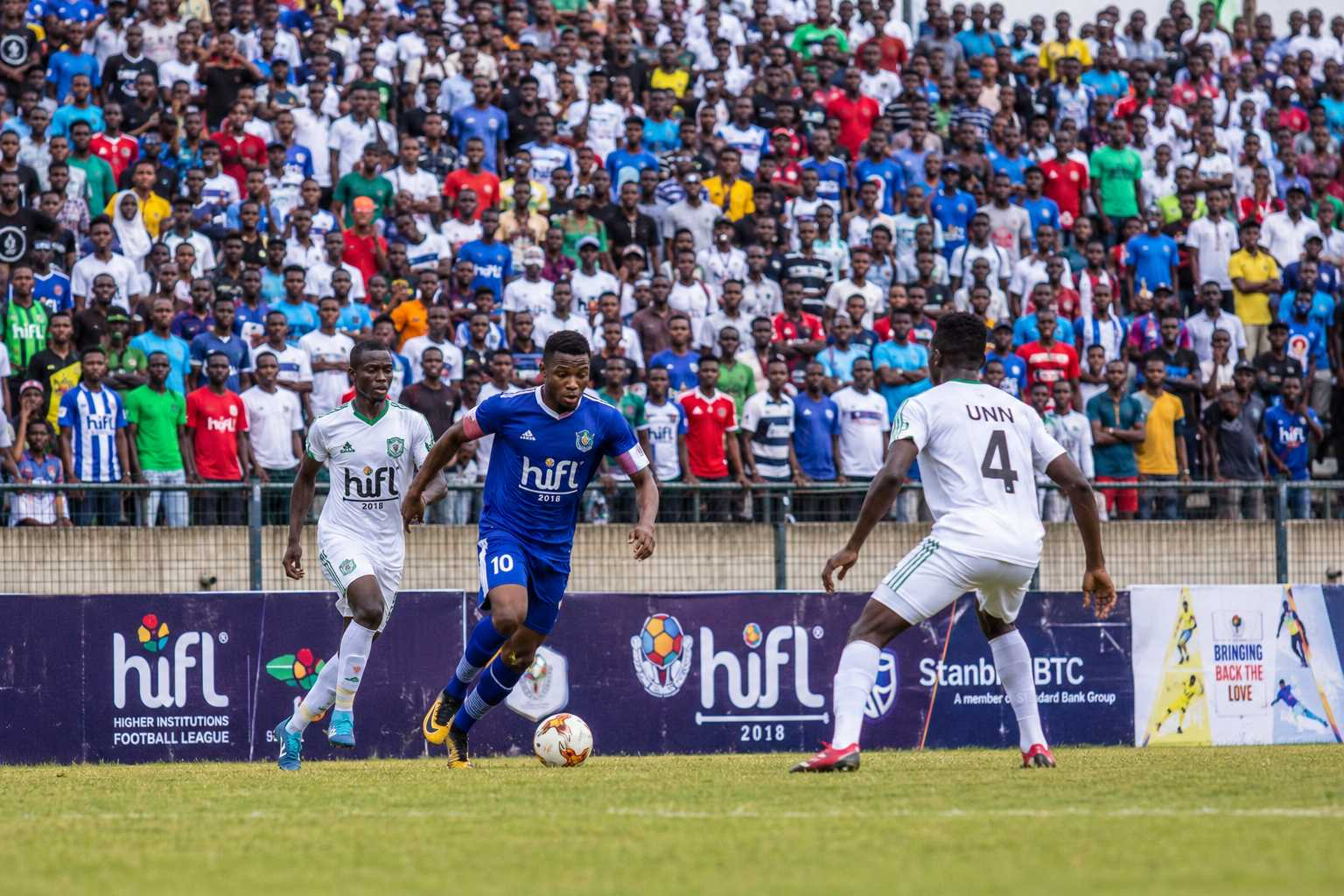
Before HiSL can be evaluated as a Series A investment, one question must be answered with evidence rather than projection: has this model been tested?
It has. Comprehensively. In Nigeria’s most complex commercial environment. And by the most demanding institutional partners in the market.
HiFL launched in 2018 with a mandate to professionalise university football in Nigeria. What it delivered over the five years that followed was not a proof of concept in the conventional startup sense, a minimum viable product tested in a controlled environment. It was a live operational deployment, tested at full scale, against real market conditions, in a country that routinely exposes structural weaknesses in commercial models that survive elsewhere.
Stanbic IBTC signed as title sponsor under a multi-year commercial agreement. MTN activated within the league’s commercial ecosystem. The Nigeria Football Federation endorsed the competition. The National Universities Commission recognised it within the higher education governance framework. These are not developmental-stage partners taking a speculative bet. These are institutional-grade operators with independent ROI measurement requirements and internal governance frameworks that make uncommitted capital structurally difficult to deploy.
By 2023, HiFL had delivered:
- 120+ universities activated within a standardised competition framework
- 38 professional athlete exports, including Robert Odu, now playing for Extremadura UD in Spain
- 120+ scholarships awarded to student-athletes
- 1 million+ students engaged across campuses
- 72+ championship-format games per season
- 2022 Presidential Recognition for Collegiate Sports Development
Each of these numbers is a data point in the same argument: the model works. Not in theory. In documented operational delivery, across Nigeria’s most complex terrain, validated by partners whose commercial standards leave no room for speculative investment.
As the G20 Sports Infrastructure Advisory stated: “evidence from the US, Europe and emerging African markets shows that when metrics, infrastructure and governance improve, capital follows.” HiFL built the metrics. HiFL built the infrastructure. HiFL built the governance. The commercial capital followed, season after season.
The 2026 HiSL season is not a fresh attempt to prove the model. It is a return to a larger mandate, with every lesson from the HiFL cycle applied, and with a commercial structure that was architecturally impossible to execute at the scale now available.
The Expansion Multiplier: Nigeria Is the Proof, Not the Ceiling
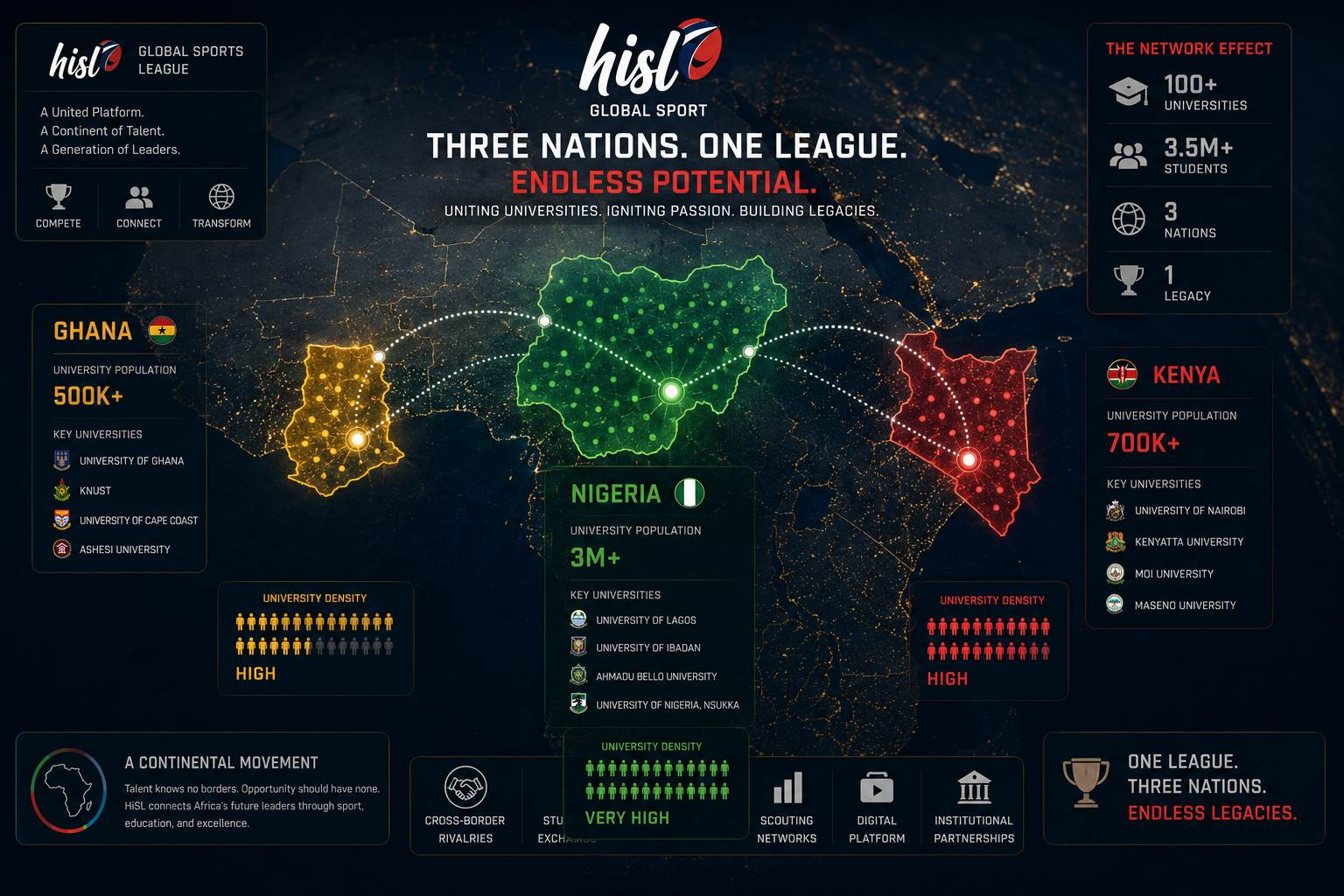
For an investor evaluating HiSL as a platform rather than a single-market league, the valuation case is not Nigeria. It is the continental network effect that Nigeria unlocks.
Ghana is a Q2 groundwork market. The timing is precise and deliberate. In March 2025, the GFA officially ended all negotiations with StarTimes on the renewal of its media broadcast rights agreement, currently demanding an outstanding debt of USD 842,173.36. While the Ghana Premier League has since awarded its broadcast rights to AFA TV and Globe TV, the collegiate sports layer,university competition below the professional tier, remains entirely unaddressed by any broadcast or commercial partner. Ghana’s media infrastructure has clarified at the professional level. The collegiate gap is untouched. HiSL’s collegiate entry occupies structurally uncontested ground.
Ivory Coast is West Africa’s most commercially dynamic French-language sports market. As the host and winner of AFCON 2023, Ivory Coast demonstrated both the institutional capacity and the commercial appetite to stage major sports events at the highest level. The country’s university system is expanding rapidly alongside one of West Africa’s fastest-growing middle-class populations. Abidjan is a media and commercial hub for the Francophone African market, which means an HiSL season in Ivory Coast creates not only domestic university sport content but a gateway to French-language broadcast distribution across West and Central Africa. No structured collegiate sports platform operates in the Ivory Coast market. The formation stage is open.
The International University Sports Federation (FISU), the global governing body for university sport across 170 national university sports federations worldwide, represents one of the most significant institutional opportunities on HiSL’s expansion horizon. FISU’s governance standards for competition formats, athlete eligibility, and international representation set the benchmark against which serious collegiate sports platforms are measured globally. Alignment with FISU standards, when pursued at the appropriate stage of HiSL’s development, would position African collegiate athletes competing in its leagues as visible and comparable to their peers in NCAA, European University Sports Association (EUSA), and Asian University Sports Federation ecosystems, a credential that carries weight with national university sports associations, government sports agencies, and international broadcast partners simultaneously. This is not a relationship HiSL is initiating today. It represents the institutional tier the platform has been intentionally structured to reach.
The expansion model is not a parallel build in each new market. It is the deployment of a single, standardised governance structure, the same operating system validated by HiFL, into markets with the institutional readiness to receive it. One governance structure. One commercial model. Multiple markets. The marginal cost of adding each new market decreases as the centralised platform infrastructure scales. The value to sponsors, who can now access a multi-market collegiate audience through a single commercial entry point, increases with each market added.
According to Future Data Stats, the global collegiate sports market was valued at $23 billion in 2025 and is projected to reach $47 billion by 2033, expanding at a CAGR of 10.8 percent. The platform that builds the African collegiate layer of that market first does not capture a share of it. It defines the terms on which everyone else participates.
Why Now: The Window Is Open and Documented
Three forces are converging simultaneously in 2026 to create the specific market conditions in which HiSL’s platform value is maximised. Each is documented. None is speculative.
Broadcast infrastructure is expanding across Africa. As Semafor reported in January 2026, AFCON 2025 announced 20 broadcast partnerships across more than 30 European territories, the highest number in the tournament’s history. Netflix rolled out a daily highlights show for AFCON in Morocco. Afreximbank has committed €245 million to finance African broadcast rights acquisition. The appetite for African sports content in international markets is accelerating. The collegiate content layer, which currently has no standardised rights package to acquire, is the natural next frontier in that sequence.
Fintech is surging into exactly the campus activation category HiSL serves. By the first half of 2025, Nigeria’s licensed mobile money providers had processed approximately ₦50 trillion in transactions, with OPay and PalmPay dominant. PalmPay alone serves over 35 million registered users, processing 15 million daily transactions. Both are competing aggressively for the university demographic, the same demographic that HiSL’s Campus Activation Partner position delivers with institutional endorsement and zero cold-visit friction. The category of brand most likely to fill HiSL’s Campus Activation Partner slots is the category currently growing fastest in the Nigerian consumer market.
Ivory Coast’s formation-stage opportunity is specifically timed. With no structured collegiate sports commercial platform operating in the market, and with the country’s sports media infrastructure energised by its AFCON 2023 success and FIFA World Cup 2026 qualification, Ivory Coast enters HiSL’s expansion sequence at precisely the moment when institutional appetite for structured sports content is highest. A first-mover collegiate season in this window positions HiSL as the foundational infrastructure for Francophone African collegiate sport, before any comparable platform forms.
“The sports, entertainment, and creative sectors are scalable industries that should be approached with effective financial tools and a genuine business mindset.”
IFC Press Release, July 2025
This Is Not a Concept. It Is a Platform Reactivating With Scale.
The argument this article makes is not theoretical. Every claim in it is supported by institutional evidence, from the IFC’s $50 million commitment to the PwC governance analysis to the NUC’s own enrolment data to the documented commercial outcomes of the HiFL operating cycle.
The NCAA did not become a $1.38 billion revenue platform because American universities had talented athletes. It became one because a governance layer was built around those athletes that made competition legible to media partners, sponsors, and institutional capital. BUCS did not become the structure for 160 UK institutions because British students wanted to compete. It became that structure because a unified governance body built the operating system that made competition consistent, scalable, and commercially valuable.
Africa has the athletes. Africa has an audience. Africa has a demographic trajectory. The structural layer to convert those inputs into institutional value is what has always been missing.
HiSL is that layer. HiFL proved it could be built. The 2026 season proves it can scale. The Q2 season is the milestone around which the institutional narrative of African collegiate sport begins to form, and it is the proof of concept that investors in this category have been waiting for.
HiSL is currently in active conversations with investors at Series A. If you are a DFI, an Africa-focused capital allocator, or a sports-specialist advisor evaluating opportunities in African collegiate sports infrastructure, the Q2 2026 season is the live proof of concept. The operational plan is documented. The commercial structure is in place. The expansion markets are identified. The institutional relationships are established.
The conversation is open.
To explore investment and partnership opportunities with HiSL Global Sport, contact the team at partnerships@hislglobal.com or visit hislglobal.com.